 Rajat Sharma
Rosuvastatin tert-Butyl Ester -A sourcing guide to this Rosuvastatin intermediate and impurity reference compound — what it is, the purity grades it’s sold under, and the specific questions to ask before you place an order.
📅 Updated July 2026 | ⏱ 9 min read | 🏷 Pharma Intermediates
Quick Answer
Rosuvastatin tert-Butyl Ester (CAS 355806-00-7, C₂₆H₃₆FN₃O₆S, MW 537.64) is sold in two distinct forms: a high-purity analytical reference standard for QC and impurity testing, and a bulk/technical-grade intermediate used in synthesis or process development. The two are not interchangeable — always confirm which one a supplier is actually quoting before you order, and be aware that much of what’s listed online is marked “Research Use Only,” which is not suitable for GMP-regulated manufacturing.
What Is Rosuvastatin tert-Butyl Ester?
Rosuvastatin tert-Butyl Ester is the tert-butyl ester form of Rosuvastatin, a widely prescribed HMG-CoA reductase inhibitor (statin) used to manage high cholesterol. Chemically, it is tert-butyl (3R,5S,6E)-7-{4-(4-fluorophenyl)-6-isopropyl-2-[methyl(methylsulfonyl)amino]-5-pyrimidinyl}-3,5-dihydroxy-6-heptenoate.
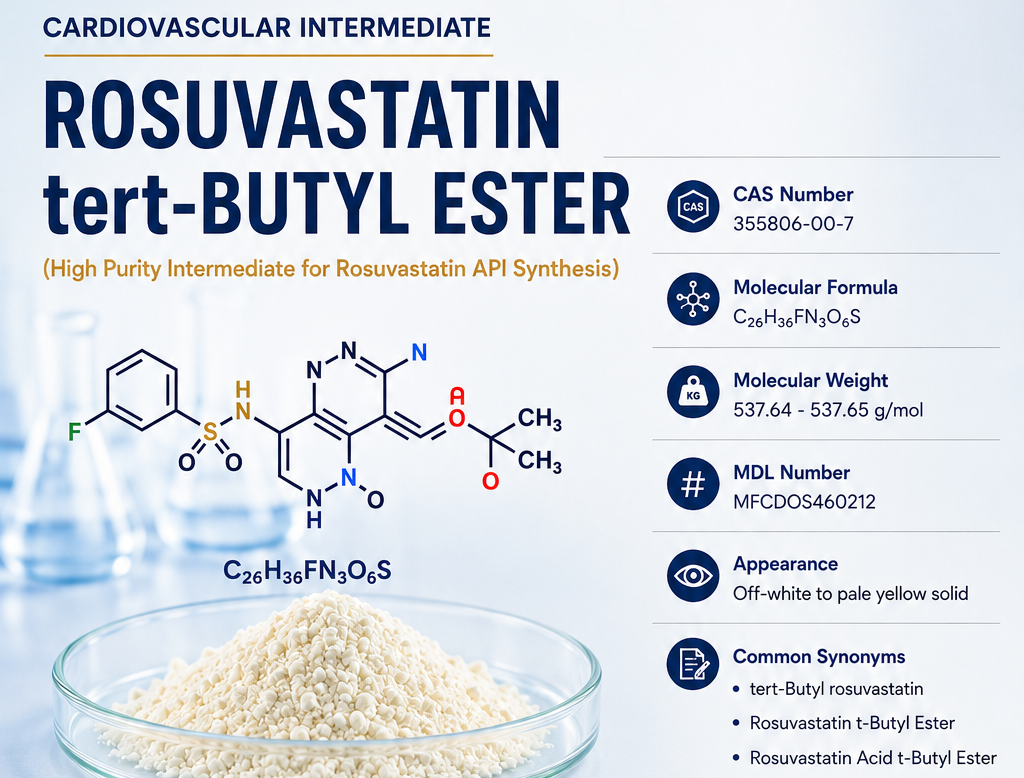
This compound plays two roles in the Rosuvastatin world. First, it functions as a synthesis intermediate — the tert-butyl ester group protects the acid functionality during earlier synthetic steps before final deprotection and salt formation into Rosuvastatin calcium. Second, it is independently recognized as a process-related impurity of Rosuvastatin, meaning finished API and drug product manufacturers need a characterized reference standard of this compound to identify and quantify it during impurity testing.
That dual role is exactly why the same CAS number shows up on both bulk-chemical supplier sites and specialty reference-standard catalogs — and why buyers need to be precise about which one they actually need.
Reference Standard vs. Bulk Intermediate — Why the Distinction Matters
These two forms differ meaningfully in how they’re characterized, packaged, and priced, and ordering the wrong one can derail a project.
Reference Standard Grade
Sold in small quantities (milligrams) by specialty biochemical and reference-standard suppliers, typically accompanied by a full analytical data package — NMR, mass spec, and HPLC purity data — and usually labeled for research or analytical use only, not for direct incorporation into a marketed drug product.
Bulk / Technical Intermediate Grade
Sold in larger quantities (grams to kilograms) by fine-chemical and API-intermediate manufacturers, generally supported by a standard Certificate of Analysis rather than a full spectroscopic data package, and intended for use in synthesis or process development rather than as an analytical reference.
Mixing these up has real consequences: a lab that orders “technical grade” expecting full characterization data will be stuck without the documentation an analytical method validation requires; a formulator who orders “reference standard” quantities expecting kilogram-scale supply will find themselves short by several orders of magnitude.
Purity Grades Available for CAS 355806-00-7
Across supplier listings, this compound is typically offered at the following purity tiers, though exact figures vary by manufacturer and should always be confirmed on the batch-specific COA:
- Reference standard grade: commonly ≥98% purity by HPLC, with a full analytical characterization package
- Standard bulk/technical grade: commonly ≥95–98% purity by HPLC, supported by a routine COA
- Research-grade (unspecified use): purity stated but without GMP support — common on catalog sites aimed at academic or R&D buyers
“Purity” itself is not a single number — it typically reflects three separate measurements that should each be checked independently:
- Assay — the percentage of the target compound by HPLC or a similar quantitative method
- Related substances — individual and total impurity levels detected alongside the main compound
- Residual solvents / water content — relevant for both handling and downstream reaction planning
Grade Comparison Table
| Attribute | Reference Standard Grade | Bulk / Technical Grade |
|---|---|---|
| Typical Assay | ≥98% HPLC, fully characterized | ≥95–98% HPLC, COA-based |
| Package Size | Milligram scale | Gram to kilogram scale |
| Documentation | NMR, MS, HPLC data package | Standard Certificate of Analysis |
| Typical Use Case | Analytical method development, impurity qualification, QC | Synthesis, process development, scale-up |
| Price Positioning | High per-milligram cost | Lower per-gram cost at volume |
What Documentation Should Accompany This Compound
Certificate of Analysis
At minimum, a usable COA should state the CAS number, batch number, assay result with the test method used, related substances (individual and total), and appearance. Anything less makes independent verification difficult.
MSDS/SDS
A current safety data sheet should be available covering hazard classification, handling precautions, and storage conditions.
Analytical Data Package for Reference Standards
If you’re buying reference-standard grade, expect — and ask for — NMR spectra, mass spectrometry data, and an HPLC chromatogram demonstrating purity, not just a stated percentage.
Structure Confirmation
Because this compound circulates under several synonyms (tert-Butyl rosuvastatin, Rosuvastatin t-Butyl Ester, and various IUPAC variants), always cross-check the CAS number and molecular formula against the structure provided, rather than relying on the product name alone.
What to Ask Suppliers Before Ordering
Supplier Question Checklist
- Which grade are you quoting — reference standard or bulk/technical intermediate?
- What test method and conditions were used for the assay (HPLC column, mobile phase, reference standard)?
- Can you provide a batch-specific COA, not a generic template?
- Is this material GMP-supported, or explicitly Research Use Only?
- What are the lead time, minimum order quantity, and packaging options?
- Can you supply NMR/MS data if I’m purchasing for reference-standard use?
Common Sourcing Risks and Red Flags
Watch For
Listings that reference only a trade or synonym name without explicitly confirming CAS 355806-00-7, or COAs that omit related-substances data and test method details entirely.
Common Mix-Up
Confusing this ester (CAS 355806-00-7) with Rosuvastatin API itself (CAS 287714-41-4) or with other Rosuvastatin-related impurities that share similar naming.
Also watch for “Research Use Only” material being represented, implicitly or explicitly, as suitable for GMP-regulated manufacturing. If GMP status isn’t stated clearly, assume it isn’t GMP-grade until confirmed in writing.
How to Evaluate and Qualify a Supplier
- Verify the CAS number and structure independently against a chemical database before accepting a supplier’s product listing at face value.
- Request a small sample for in-house testing before committing to a larger order, especially for a new supplier.
- Check COA consistency across batches — genuine test data varies slightly batch to batch; identical figures across multiple COAs is a warning sign.
- Get GMP status confirmed explicitly, in writing, rather than inferring it from general marketing language.
Reminder: CAS numbers, purity figures, and grade availability should always be confirmed directly against the supplier’s current, batch-specific COA before purchase. Figures in this article reflect typical, publicly listed specifications and are not a substitute for supplier-issued documentation.
Frequently Asked Questions
What is Rosuvastatin tert-Butyl Ester used for?
It functions as a synthesis-stage intermediate in Rosuvastatin tert-Butyl Ester manufacturing and, separately, as an analytical reference standard used to identify and quantify this compound as a process-related impurity in finished Rosuvastatin API or drug product.
Is CAS 355806-00-7 the same as Rosuvastatin API?
No. CAS 355806-00-7 is the tert-butyl ester form, distinct from Rosuvastatin API itself, which is registered under CAS 287714-41-4. The ester is a precursor or related impurity, not the active pharmaceutical ingredient.
What purity grade should I choose — reference standard or bulk intermediate?
Choose reference standard grade for analytical method development, impurity qualification, or QC testing. Choose bulk or technical intermediate grade if you need commercial quantities for synthesis or process development, where full analytical characterization data isn’t required.
Do I need a DMF for this intermediate?
Generally no. As an intermediate, it is typically supported by a Certificate of Analysis and technical specification sheet rather than a DMF, which applies to the finished API.
Can this compound be sourced for GMP-regulated manufacturing?
Only if the supplier explicitly confirms GMP-grade production and documentation. Many listings for this compound are marked Research Use Only, which is not suitable for regulated pharmaceutical manufacturing.
Conclusion — Sourcing CAS 355806-00-7 with Confidence
Rosuvastatin tert-Butyl Ester is a well-characterized, widely available compound — but its dual identity as both a synthesis intermediate and an impurity reference standard means the details matter more than usual. Before ordering, confirm exactly which grade you’re buying, insist on batch-specific documentation rather than generic COAs, and verify GMP status explicitly if your end use requires it. Getting these details right up front avoids costly delays later in method validation or regulatory filing.
Follow us on Instagram : rokadoverseas