 Rajat Sharma
An introductory guide to the key synthesis intermediates behind four major DPP-4 Inhibitor -Gliptin Intermediates — and why this drug class doesn’t share a single, common intermediate supply chain the way some other therapeutic classes do.
📅 Updated August 2026 | ⏱ 10 min read | 🏷 API Chemistry
Quick Answer
DPP-4 Inhibitor -Gliptin Intermediates all share the same mechanism of action, but they were developed around four structurally distinct core scaffolds, so each has its own dedicated synthesis intermediates. Vildagliptin and saxagliptin are built from an adamantane-based side chain, while linagliptin and alogliptin — despite different core scaffolds — both rely on the same key building block, (R)-3-aminopiperidine. Understanding which intermediates belong to which drug is the first step before sourcing any of them.
What Are DPP-4 Inhibitor -Gliptin Intermediates?
DPP-4 Inhibitor -Gliptin Intermediates, commonly called gliptins, are a class of oral antidiabetic drugs that work by blocking the dipeptidyl peptidase-4 enzyme. Under normal conditions, DPP-4 breaks down incretin hormones like GLP-1 shortly after they’re released. By inhibiting this enzyme, gliptins prolong incretin activity, which increases insulin secretion and lowers blood glucose in a glucose-dependent manner.
This drug class has become a mainstay of type 2 diabetes management, valued for its relatively low hypoglycemia risk compared to older antidiabetic classes. Vildagliptin, saxagliptin, linagliptin, and alogliptin are four of the most widely manufactured gliptins globally, each developed independently by a different originator company.
For anyone working in API sourcing, formulation, or pharmaceutical chemistry, understanding gliptin intermediates matters because — unlike some drug classes where generics share a common upstream supply chain — each gliptin’s intermediates are largely specific to that molecule.
Why DPP-4 Inhibitor -Gliptin Intermediates Differ So Much Across the Class
It’s tempting to assume that drugs in the same therapeutic class share similar building blocks, but gliptins are a clear counterexample. Each of the four drugs covered here was built around a different core chemical scaffold:
- Vildagliptin — adamantane-pyrrolidine carbonitrile scaffold
- Saxagliptin — adamantane-azabicyclohexane carbonitrile scaffold
- Linagliptin — xanthine (purine-2,6-dione) scaffold
- Alogliptin — pyrimidinedione scaffold
Because these scaffolds are structurally unrelated, each requires its own distinct synthesis route and, in most cases, its own dedicated intermediates. The practical implication for sourcing: there is no single “gliptin intermediate” supply chain to tap into — each drug needs to be researched and sourced on its own terms, with one notable partial exception covered below.
Vildagliptin Intermediates
Vildagliptin
CAS Number: 274901-16-5
Molecular Formula: C₁₇H₂₅N₃O₂
Molecular Weight: 303.4 g/mol
IUPAC Name: (2S)-1-[2-[(3-hydroxy-1-adamantyl)amino]acetyl]pyrrolidine-2-carbonitrile
Vildagliptin (originally developed under the code LAF237) couples an adamantane-derived amino alcohol fragment with a pyrrolidine carbonitrile fragment. This two-fragment coupling is one of the more straightforward routes within the gliptin class.
Key Intermediate
3-Amino-1-adamantanol — CAS 702-82-9, C₁₀H₁₇NO, MW 167.25. This adamantane-based amino alcohol is explicitly identified across supplier catalogs as “Vildagliptin Intermediate 1” and reacts with a glycine-linked pyrrolidine fragment to build the final molecule.
Saxagliptin Intermediates
Saxagliptin
CAS Number: 361442-04-8
Molecular Formula: C₁₈H₂₅N₃O₂
Molecular Weight: 315.41 g/mol
IUPAC Name: (1S,3S,5S)-2-[(2S)-2-amino-2-(3-hydroxy-1-adamantyl)acetyl]-2-azabicyclo[3.1.0]hexane-3-carbonitrile
Saxagliptin (originally developed under the code BMS-477118) shares a family resemblance with vildagliptin — both incorporate a 3-hydroxyadamantyl fragment — but saxagliptin pairs it with an azabicyclo[3.1.0]hexane carbonitrile core rather than vildagliptin’s simple pyrrolidine ring. This bicyclic core is the structural feature that most distinguishes saxagliptin’s synthesis route from vildagliptin’s.
Key Building Block Family
Saxagliptin’s synthesis draws on the same 3-hydroxyadamantyl-glycine building block family used in vildagliptin production, combined with a distinct azabicyclohexane carbonitrile fragment specific to saxagliptin. The two drugs are related in one fragment but not interchangeable, since the bicyclic core fragment is unique to saxagliptin.
Linagliptin Intermediates
Linagliptin
CAS Number: 668270-12-0
IUPAC Name: 8-[(3R)-3-aminopiperidin-1-yl]-7-(but-2-yn-1-yl)-3-methyl-1-[(4-methylquinazolin-2-yl)methyl]-3,7-dihydro-1H-purine-2,6-dione
Linagliptin (developed under the code BI-1356) is built on a xanthine (purine-2,6-dione) core — structurally unrelated to either the adamantane-based gliptins or alogliptin’s pyrimidinedione core. Its synthesis involves constructing the substituted xanthine scaffold and then introducing a chiral aminopiperidine side chain along with a quinazoline-methyl substituent.
Key Intermediate
(R)-3-Aminopiperidine Dihydrochloride — CAS 334618-23-4, C₅H₁₄Cl₂N₂, MW 173.08. This chiral amine is introduced onto the xanthine core late in the synthesis and is explicitly documented across supplier catalogs as a linagliptin intermediate.
Alogliptin Intermediates
Alogliptin
CAS Number: 850649-61-5
Molecular Formula: C₁₈H₂₁N₅O₂
Molecular Weight: 339.39 g/mol
IUPAC Name: 2-({6-[(3R)-3-aminopiperidin-1-yl]-3-methyl-2,4-dioxo-3,4-dihydropyrimidin-1(2H)-yl}methyl)benzonitrile
Alogliptin is built on a pyrimidinedione core rather than linagliptin’s xanthine core, even though both molecules carry the same chiral aminopiperidine side chain. The benzonitrile-methyl substituent and the pyrimidinedione ring system are what distinguish alogliptin’s route from linagliptin’s.
Key Intermediate
(R)-3-Aminopiperidine Dihydrochloride — CAS 334618-23-4. The same chiral amine used in linagliptin production is also the key intermediate for alogliptin (and for trelagliptin, a related gliptin), making this one of the few genuinely shared building blocks across the DPP-4 inhibitor class.
Side-by-Side Comparison of DPP-4 Inhibitor -Gliptin Intermediates
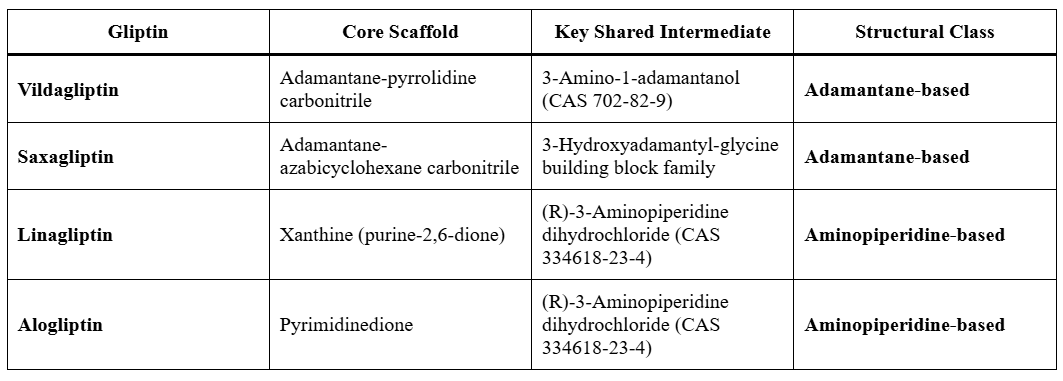
The gliptin class splits into two intermediate families — adamantane-based (vildagliptin, saxagliptin) and aminopiperidine-based (linagliptin, alogliptin) — despite all four sharing the same mechanism of action.
Why This Matters for API Manufacturers and Formulators
Intermediate quality carries directly into the final API’s impurity profile — an inconsistent or poorly characterized intermediate batch can introduce related substances that are difficult or costly to remove downstream. This is particularly relevant for the gliptin class, which, like several other therapeutic categories, has drawn regulatory attention around genotoxic impurity assessment in recent years.
Before sourcing any gliptin intermediate, it’s worth understanding exactly which drug it belongs to and which synthesis stage it represents — the (R)-3-aminopiperidine example above shows that some cross-drug overlap does exist, but it’s the exception rather than the rule. Confirming CAS number, molecular structure, and documented end-use (which specific gliptin) against a supplier’s Certificate of Analysis is the starting point for any sourcing decision in this category.
Frequently Asked Questions
What is a DPP-4 Inhibitor -Gliptin Intermediates?
A DPP-4 Inhibitor -Gliptin Intermediates, is a class of oral antidiabetic medication that blocks the dipeptidyl peptidase-4 enzyme, extending the activity of incretin hormones that help regulate blood glucose. Vildagliptin, saxagliptin, linagliptin, and alogliptin are among the most widely used gliptins.
Why do vildagliptin, saxagliptin , linagliptin, and alogliptin have such different synthesis routes?
Although all four drugs share the same mechanism of action, they were developed independently by different companies around structurally distinct core scaffolds — adamantane-pyrrolidine for vildagliptin, adamantane-azabicyclohexane for saxagliptin, a xanthine core for linagliptin, and a pyrimidinedione core for alogliptin. Different scaffolds require different synthesis routes and different intermediates.
Are gliptin intermediates interchangeable across different drugs in the class?
Generally no, with one notable exception: linagliptin and alogliptin both rely on (R)-3-aminopiperidine as a key building block, since both incorporate the same aminopiperidine side chain. Vildagliptin and saxagliptin share a related adamantane-based building block family but use different core scaffolds, so their intermediates are not directly interchangeable.
What should I look for when researching a gliptin intermediate supplier?
Confirm the exact CAS number and structure of the intermediate you need, since gliptin intermediates are not interchangeable across the drug class. Also check for WHO-GMP certification, batch-specific Certificate of Analysis, and impurity data given the regulatory attention on genotoxic impurities in this therapeutic category.
Which gliptin has the simplest synthesis route?
Vildagliptin is generally considered to have one of the more straightforward synthesis routes within the class, involving a coupling between an adamantane-based amino alcohol and a pyrrolidine carbonitrile fragment, though complexity assessments vary by manufacturing process and process patents in use.
Conclusion — Understanding DPP-4 Inhibitor -Gliptin Intermediates Before You Source
The DPP-4 Inhibitor -Gliptin Intermediates class is a good reminder that shared mechanism of action doesn’t mean shared chemistry. Vildagliptin and saxagliptin draw from an adamantane-based intermediate family, while linagliptin and alogliptin — despite entirely different core scaffolds — converge on the same chiral aminopiperidine building block. Knowing which family a given gliptin belongs to, and which specific intermediate stage you actually need, is the essential first step before evaluating any supplier’s spec sheet or COA.
Sourcing a specific gliptin intermediate?
Explore our detailed specification guides for individual gliptin intermediates, including verified CAS numbers, grade options, and supplier vetting guidance.
for more check Instagram: Rokad overseas