 Rajat Sharma
An introductory guide to dapagliflozin’s mechanism of action and synthesis route — including a closer look at the aryl-fragment and glycosylation-stage intermediates commonly referred to by shorthand like “DAPA-I” and “DAPA-II.”
📅 Updated August 2026 | ⏱ 9 min read | 🏷 API Chemistry
Quick Answer
Dapagliflozin (CAS 461432-26-8) is an SGLT2 inhibitor used to treat type 2 diabetes, and more recently, certain heart failure and chronic kidney disease conditions. Its synthesis proceeds through an early-stage aryl fragment and an advanced-stage glycosylated intermediate before final deprotection. “DAPA-I” and “DAPA-II” are informal trade shorthand some suppliers use for these stages — not standardized names — so confirming the actual CAS number and structure behind any such code is essential before sourcing.
What Is Dapagliflozin?
CAS Number: 461432-26-8
Molecular Formula: C₂₁H₂₅ClO₆
Molecular Weight: 408.87 g/mol
Development Code: BMS-512148
IUPAC Name: (2S,3R,4R,5S,6R)-2-[4-chloro-3-[(4-ethoxyphenyl)methyl]phenyl]-6-(hydroxymethyl)oxane-3,4,5-triol
Dapagliflozin was jointly developed by Bristol-Myers Squibb and AstraZeneca and approved by the European Medicines Agency in November 2012, becoming the first SGLT2 inhibitor approved for type 2 diabetes treatment; US FDA approval followed in January 2014. It’s marketed under the brand name Farxiga (Forxiga in some markets).
Mechanistically, dapagliflozin inhibits SGLT2 (sodium-glucose cotransporter-2), a protein in the kidney responsible for reabsorbing glucose back into the bloodstream during blood filtration. By blocking SGLT2, dapagliflozin causes excess glucose to be excreted in urine instead of reabsorbed, lowering blood glucose independent of insulin activity. Since its original diabetes approval, dapagliflozin has also gained approval for certain heart failure and chronic kidney disease indications, reflecting benefits that extend beyond glycemic control.
Dapagliflozin’s Place in the SGLT2 Inhibitor (Gliflozin) Class
Dapagliflozin belongs to the broader “gliflozin” class of SGLT2 inhibitors, alongside drugs like empagliflozin and canagliflozin. All gliflozins share the same general mechanism — SGLT2 inhibition — and a broadly similar structural strategy: an aromatic core fragment linked to a sugar (glycoside) moiety. But the specific aryl substituents, the linking chemistry, and therefore the specific intermediates differ meaningfully between drugs in this class, similar to the pattern seen across the DPP-4 inhibitor (gliptin) class discussed in our companion article.
For anyone in API sourcing or process chemistry, this means dapagliflozin’s intermediates are specific to dapagliflozin — they aren’t a drop-in match for empagliflozin or canagliflozin production, even though all three drugs are mechanistically related.
Overview of the Dapagliflozin Synthesis Route
At a high level, dapagliflozin’s synthesis follows a strategy common across the gliflozin class: build the chlorinated, ethoxybenzyl-substituted aromatic core first, then couple it to a protected glucose-derived sugar unit, and finally remove the protecting groups to reveal the free triol.
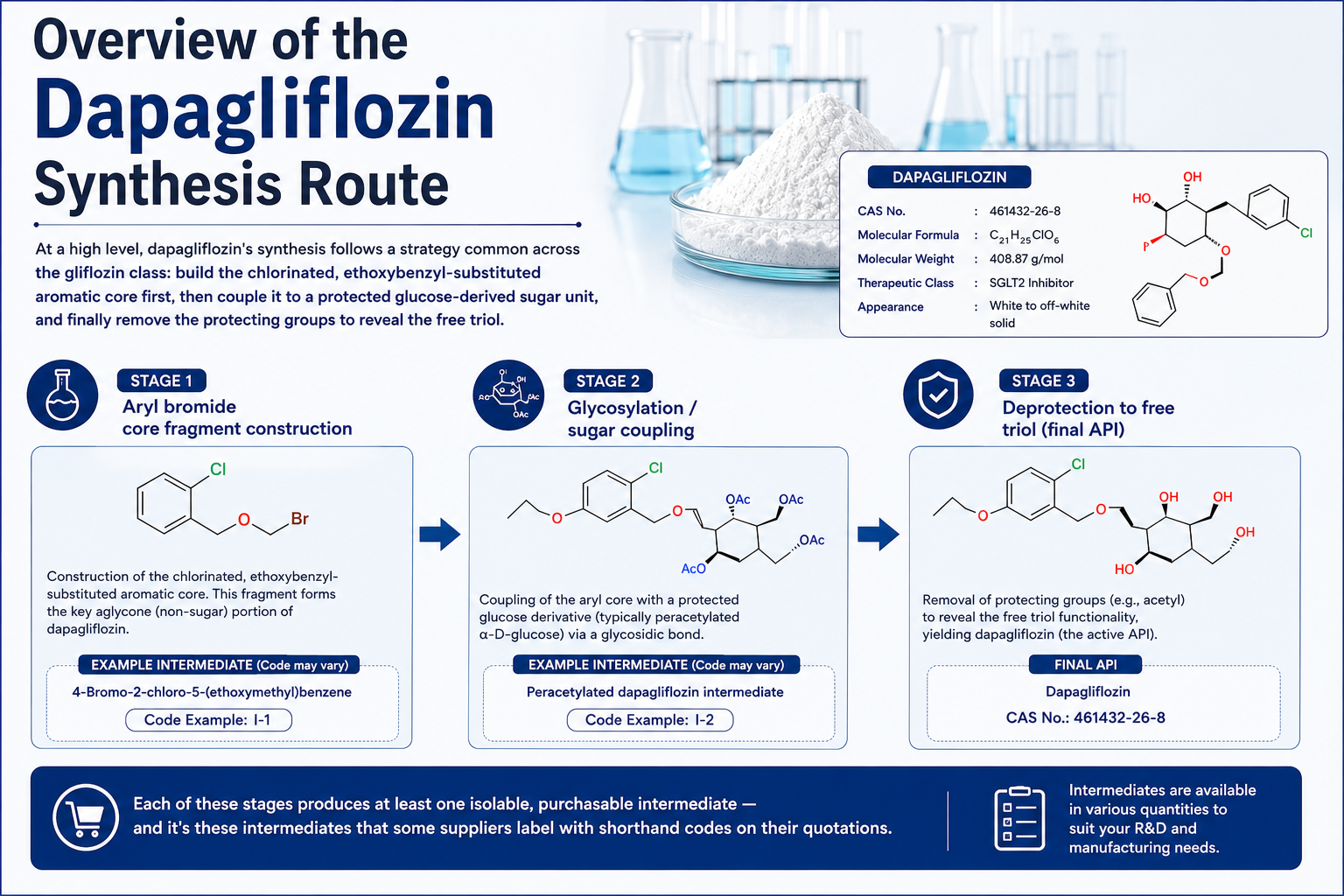
Each of these stages produces at least one isolable, purchasable intermediate — and it’s these intermediates that some suppliers label with shorthand codes on their quotations.
Understanding “DAPA-I” and “DAPA-II” as Intermediate Codes
A note on naming: “DAPA-I” and “DAPA-II” are not standardized, CAS-registered chemical names. In our research, we could not locate a public chemical database, patent, or independent supplier reference that consistently maps these codes to one specific structure. Like the “DPA/LRD/LRCII” shorthand seen in Lercanidipine sourcing, these appear to be internal trade labels that individual manufacturers assign on their own quotations — meaning the same code could refer to different compounds, or different purity grades of the same compound, depending on who issued it.
What we can say with confidence, based on public patent literature and supplier documentation, is that dapagliflozin’s synthesis does involve at least two major purchasable intermediate stages — an early aryl-fragment stage and a later glycosylated stage — which is likely what suppliers are informally referring to when they use “DAPA-I” and “DAPA-II” on a quotation. The verified compounds behind those stages are detailed below.
Early-Stage Aryl Intermediate
Stage 1 — Aryl Core Fragment
Public patent literature and supplier catalogs document an early-stage bromo-aryl building block used in dapagliflozin synthesis:
4-(5-Bromo-2-chlorobenzyl)phenyl ethyl ether
This fragment supplies the chlorinated, ethoxybenzyl-substituted aromatic core that will later be coupled to the sugar unit. Its role is analogous to the aglycone-building stage seen in other gliflozin syntheses — establishing the core scaffold before any glycosylation chemistry takes place.
Advanced-Stage Glycosylated Intermediate
Stage 2 — Glycosylation / Sugar Coupling
Once the aryl core is established, it’s coupled to a protected sugar moiety. Two related advanced-stage intermediates appear consistently across supplier documentation and patent literature:
CAS 461432-25-7 — (2S,3R,4R,5S,6R)-2-[4-chloro-3-(4-ethoxybenzyl)phenyl]-6-(hydroxymethyl)-2-ethoxytetrahydro-2H-pyran-3,4,5-triol
This ethyl-glycoside intermediate is one step removed from the final deprotected API, and is explicitly documented by Indian API-intermediate manufacturers as a dapagliflozin-specific building block.
Peracetylated intermediate — (2S,3R,4R,5S,6R)-2-(Acetoxymethyl)-6-[4-chloro-3-(4-ethoxybenzyl)phenyl]tetrahydro-2H-pyran-3,4,5-triyl triacetate
This triacetate form — the sugar hydroxyl groups protected as acetate esters — represents a further downstream stage, closer to the final API, requiring only deacetylation to reveal dapagliflozin’s free triol.
Purity and stereochemical control at this stage matter significantly, since any impurity carried through deprotection ends up directly in the finished API’s impurity profile.
Why Intermediate Quality Matters in Dapagliflozin Manufacturing
Because the glycosylation stage sets the stereochemistry that defines the final molecule, inconsistent quality at this stage — wrong anomer ratio, incomplete protection, or residual coupling byproducts — carries directly into the finished API’s impurity profile and can be difficult to correct downstream. This is a common theme across SGLT2 inhibitor manufacturing broadly, not unique to dapagliflozin, and it’s part of why regulators pay close attention to related-substance control for this drug class.
For anyone evaluating a dapagliflozin intermediate supplier, the starting point is the same lesson from the naming discussion above: confirm CAS number, molecular structure, and synthesis stage directly against the supplier’s own documentation, rather than relying on a trade code alone.
Frequently Asked Questions
What is dapagliflozin used for?
Dapagliflozin is used to improve glycemic control in adults with type 2 diabetes, and has since also been approved for certain heart failure and chronic kidney disease indications, independent of diabetes status.
How does dapagliflozin work (mechanism of action)?
Dapagliflozin inhibits SGLT2 (sodium-glucose cotransporter-2) in the kidney, which normally reabsorbs glucose back into the bloodstream. By blocking SGLT2, dapagliflozin causes excess glucose to be excreted in urine instead, lowering blood glucose levels.
What are DAPA-I and DAPA-II intermediates?
DAPA-I and DAPA-II are informal trade shorthand some suppliers use to label early-stage and advanced-stage dapagliflozin synthesis intermediates. They are not standardized, CAS-registered names, so the same code can refer to different compounds depending on the manufacturer. Always confirm the actual CAS number and structure behind any trade code before ordering.
Are DAPA-I/DAPA-II standardized names across all manufacturers?
No. Unlike a CAS Registry Number, trade codes like DAPA-I and DAPA-II are assigned independently by each supplier and are not standardized across the industry, so verifying the underlying chemical identity is essential before sourcing.
Is dapagliflozin’s synthesis similar to other SGLT2 inhibitors?
Broadly yes, in that most SGLT2 inhibitors (gliflozins) share a general strategy of coupling an aryl core to a sugar (glycoside) moiety, but the specific substituents, coupling chemistry, and intermediates differ between dapagliflozin, empagliflozin, canagliflozin, and other drugs in the class.
Conclusion — Understanding Dapagliflozin Chemistry Before Going Further
Dapagliflozin’s core identity is well established and easy to verify — CAS 461432-26-8, an SGLT2 inhibitor built around a chlorinated ethoxybenzyl aryl core coupled to a glucose-derived sugar unit. Its intermediates follow a two-major-stage pattern: an aryl-fragment stage and a glycosylation stage, each with real, CAS-documented compounds behind them. Where “DAPA-I” and “DAPA-II” show up on a supplier’s quotation, treat them as a starting point for a conversation, not a specification — confirm the real chemistry behind the code before you go any further.
Researching SGLT2 inhibitor intermediates further?
Explore our specification guides for individual gliflozin-class intermediates, including verified CAS numbers, grade options, and supplier vetting guidance.