 Rajat Sharma
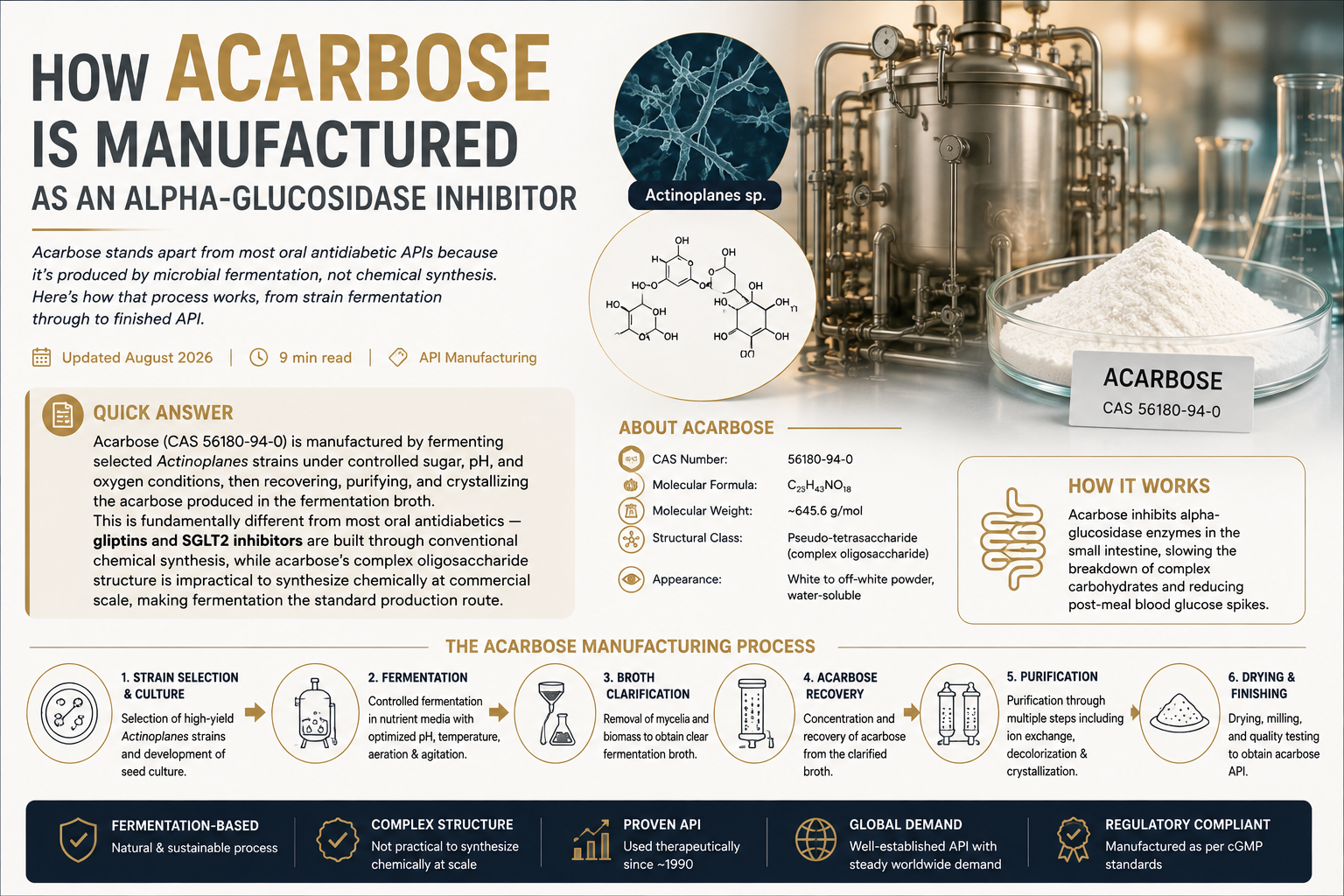
How Acarbose Is Manufactured: Alpha-Glucosidase Inhibitor : Acarbose stands apart from most oral antidiabetic APIs because it’s produced by microbial fermentation, not chemical synthesis. Here’s how that process works, from strain fermentation through to finished API.
📅 Updated August 2026⏱ 9 min read🏷 API Manufacturing
Quick Answer
Acarbose (CAS 56180-94-0) is manufactured by fermenting selected Actinoplanes strains under controlled sugar, pH, and oxygen conditions, then recovering, purifying, and crystallizing the acarbose produced in the fermentation broth. This is fundamentally different from most oral antidiabetics — gliptins and SGLT2 inhibitors are built through conventional chemical synthesis, while acarbose’s complex oligosaccharide structure is impractical to synthesize chemically at commercial scale, making fermentation the standard production route.
What Is Acarbose and How Acarbose Is Manufactured: Alpha-Glucosidase Inhibitor?
CAS Number56180-94-0Molecular FormulaC₂₅H₄₃NO₁₈Molecular Weight~645.6 g/molStructural ClassPseudo-tetrasaccharide (complex oligosaccharide)AppearanceWhite to off-white powder, water-soluble
Acarbose is an alpha-glucosidase inhibitor used in the management of type 2 diabetes, marketed under brand names including Precose (US) and Glucobay (Europe, China, and other markets). It has been used therapeutically since around 1990.
Mechanistically, acarbose works in the small intestine rather than systemically. It competitively and reversibly inhibits alpha-glucosidase enzymes located in the brush border of the intestinal wall — enzymes normally responsible for breaking down complex carbohydrates (starches, dextrins, disaccharides) into absorbable glucose. By slowing this breakdown, acarbose flattens and delays the post-meal rise in blood glucose. Notably, it does not stimulate insulin secretion, distinguishing its mechanism from sulfonylureas and giving it a different side-effect profile — most commonly gastrointestinal effects like flatulence, caused by undigested carbohydrate reaching the colon where gut bacteria ferment it.
This mechanism is entirely different from the gliptins and SGLT2 inhibitors covered in our companion articles, both of which act on glucose regulation through the kidney or incretin pathways rather than directly slowing carbohydrate digestion in the gut.
Why Acarbose Is Manufactured Differently From Most Oral Antidiabetics
Most oral antidiabetic APIs — gliptins, SGLT2 inhibitors, sulfonylureas, biguanides like metformin — are small molecules built through conventional synthetic organic chemistry: a series of chemical reactions run in reactors, using purchased or synthesized intermediates. Acarbose breaks this pattern entirely.
Structurally, acarbose is a pseudo-tetrasaccharide — a complex, four-unit sugar-like molecule with an unusual unsaturated cyclitol ring fused into an amino-sugar backbone. Building this level of structural complexity through step-by-step chemical synthesis would require an impractically long synthetic route with poor overall yield. Nature already solved this problem: certain soil bacteria biosynthesize acarbose naturally as part of a broader secondary metabolite complex, making microbial fermentation the practical, commercially viable production route.
The practical implication for manufacturers: producing acarbose API requires fermentation microbiology capability — strain maintenance, bioreactor operation, broth processing — not just synthetic organic chemistry expertise. This is a genuinely different manufacturing competency, closer to what’s needed for antibiotics like erythromycin than for a typical small-molecule oral antidiabetic.
The Fermentation Process Behind Acarbose Production
Producing Microorganism
Acarbose is produced by fermentation of bacteria from the genus Actinoplanes, most commonly cited in literature and supplier documentation as Actinoplanes utahensis. Industrial production has also been documented using various named production strains — for example, Actinoplanes sp. A56 and Actinoplanes sp. CKD485-16 appear in peer-reviewed fermentation optimization studies — reflecting that individual manufacturers typically maintain their own proprietary or licensed production strain.
Fermentation Conditions
Published industrial fermentation studies point to a few consistent process levers that influence acarbose yield:
- Total sugar concentration in the fermentation broth — too little limits yield, too much can inhibit cell growth
- pH control — typically maintained in a narrow near-neutral range during production
- Dissolved oxygen (DO) level — aeration is carefully controlled, since this is an aerobic fermentation
- Osmolality of the broth — documented in the literature as a meaningful lever for acarbose titer, with production-phase osmolality typically kept higher than the initial growth-phase osmolality
One published industrial-scale study using a 30,000-liter fermenter reported acarbose titers reaching approximately 5,000 mg/L after 168 hours of fermentation under optimized conditions — illustrating both the scale at which this process runs commercially and the multi-day fermentation cycle typical of this production method.
Step 1Strain fermentation (bioreactor)
→
Step 2Broth clarification & recovery
→
Step 3Chromatographic purification
→
Step 4Crystallization & isolation
→
Step 5QC testing & release
From Fermentation Broth to Purified Acarbose API
1
Broth Clarification and Initial Recovery
Once fermentation is complete, the broth — now containing acarbose along with cell biomass, unused nutrients, and other metabolites — is clarified to separate the liquid fraction from the microbial cells and solid debris, typically through filtration or centrifugation.
2
Chromatographic Purification
The clarified liquid still contains related fermentation byproducts and other metabolites structurally similar to acarbose (since it’s produced as part of a broader “amylostatin complex” of related compounds). Chromatographic separation techniques are used to isolate acarbose from these closely related substances — a critical step, since these related compounds are exactly the kind of impurities regulators expect to see characterized and controlled in the final API’s specification.
3
Crystallization and Isolation
The purified acarbose fraction is then crystallized and isolated as a solid, yielding the white to off-white crystalline powder that constitutes the finished active pharmaceutical ingredient.
4
Quality Control Checkpoints
Throughout this sequence, in-process and final QC testing confirms assay, related-substance levels, and identity, ensuring the isolated API meets pharmacopoeial and internal specification requirements before batch release.
Key Manufacturing and Quality Considerations for Acarbose API
Fermentation-derived APIs carry a different quality risk profile than synthetic APIs. Batch-to-batch consistency depends heavily on strain stability, fermentation reproducibility, and tight process control — variables that simply don’t exist in a purely chemical synthesis route, where the same reagents under the same conditions reliably produce the same outcome.
Because acarbose is produced alongside structurally related metabolites in the same fermentation, related-substance control is a central QC focus — arguably more so than for many synthetic small molecules, where impurities tend to arise from a more limited, well-characterized set of side reactions. Manufacturers and buyers evaluating acarbose API quality should expect and look for detailed related-substance data in the Certificate of Analysis, not just an overall assay figure.
Acarbose Manufacturing vs. Synthetic Oral Antidiabetic APIs
| Factor | Acarbose (Fermentation-Derived) | Typical Synthetic Oral Antidiabetic API |
|---|---|---|
| Production Method | Microbial fermentation (Actinoplanes) | Multi-step chemical synthesis |
| Core Manufacturing Capability Needed | Fermentation microbiology, bioreactor operation | Synthetic organic chemistry, reaction engineering |
| Batch Consistency Drivers | Strain stability, fermentation reproducibility | Reagent purity, reaction control |
| Typical Impurity Profile Focus | Related fermentation metabolites (amylostatin complex) | Synthesis byproducts, residual solvents |
Why This Matters for API Manufacturers and Buyers
Evaluating an acarbose API manufacturer requires a different due-diligence lens than evaluating a synthetic API supplier. Fermentation-specific capability — strain maintenance protocols, bioreactor scale and control systems, and downstream purification expertise for complex oligosaccharides — matters as much as, or more than, general synthetic GMP experience.
For buyers, this means the standard supplier vetting questions still apply (WHO-GMP certification, batch-specific COA, related-substance data), but it’s also worth specifically asking about fermentation process control and strain consistency practices, since these are the primary levers affecting batch-to-batch reliability for this particular API.
Frequently Asked Questions
What is acarbose used for?
Acarbose is used to manage blood glucose levels in type 2 diabetes by slowing carbohydrate digestion in the small intestine, which reduces the post-meal rise in blood glucose.
Which microorganism is used to produce acarbose?
Acarbose is produced by fermentation of Actinoplanes species, most commonly cited as Actinoplanes utahensis, with various industrial strains documented in the scientific literature under different designations.
Is acarbose made through chemical synthesis or fermentation?
Acarbose is produced primarily through microbial fermentation rather than pure chemical synthesis, since its complex pseudo-tetrasaccharide structure is impractical to build through conventional synthetic chemistry at commercial scale.
How does acarbose work as an alpha-glucosidase inhibitor?
Acarbose competitively and reversibly inhibits alpha-glucosidase enzymes in the brush border of the small intestine, delaying the breakdown of complex carbohydrates into absorbable glucose and producing a slower, smaller rise in post-meal blood glucose.
Why is acarbose manufacturing different from other oral antidiabetic APIs?
Most oral antidiabetic APIs, including gliptins and SGLT2 inhibitors, are produced through conventional synthetic organic chemistry. Acarbose instead requires fermentation microbiology capability, along with downstream purification methods suited to a complex oligosaccharide, making its production process fundamentally different from a typical small-molecule API.
Conclusion — Understanding Acarbose Manufacturing Before Going Further
Acarbose is a good reminder that “oral antidiabetic API” doesn’t imply a single manufacturing playbook. While gliptins and SGLT2 inhibitors are built through conventional synthetic chemistry, acarbose’s complex oligosaccharide structure is a product of biology, not synthesis — fermented by Actinoplanes bacteria, then recovered, purified, and crystallized into finished API. For anyone evaluating a supplier or planning manufacturing capability around acarbose, that distinction — fermentation microbiology versus synthetic chemistry — is the essential starting point.
Visit our instagram: rokadoverseas