 Rajat Sharma
Why Diabetes API Demand Is Growing- Rising prevalence, a growing population, and improving treatment access are converging in a region that also happens to house much of the world’s generic API manufacturing capacity — a combination that makes South and Southeast Asia uniquely important for antidiabetic API demand.
📅 Updated August 2026 | ⏱ 10 min read | 🏷 API Market Insight
Quick Answer
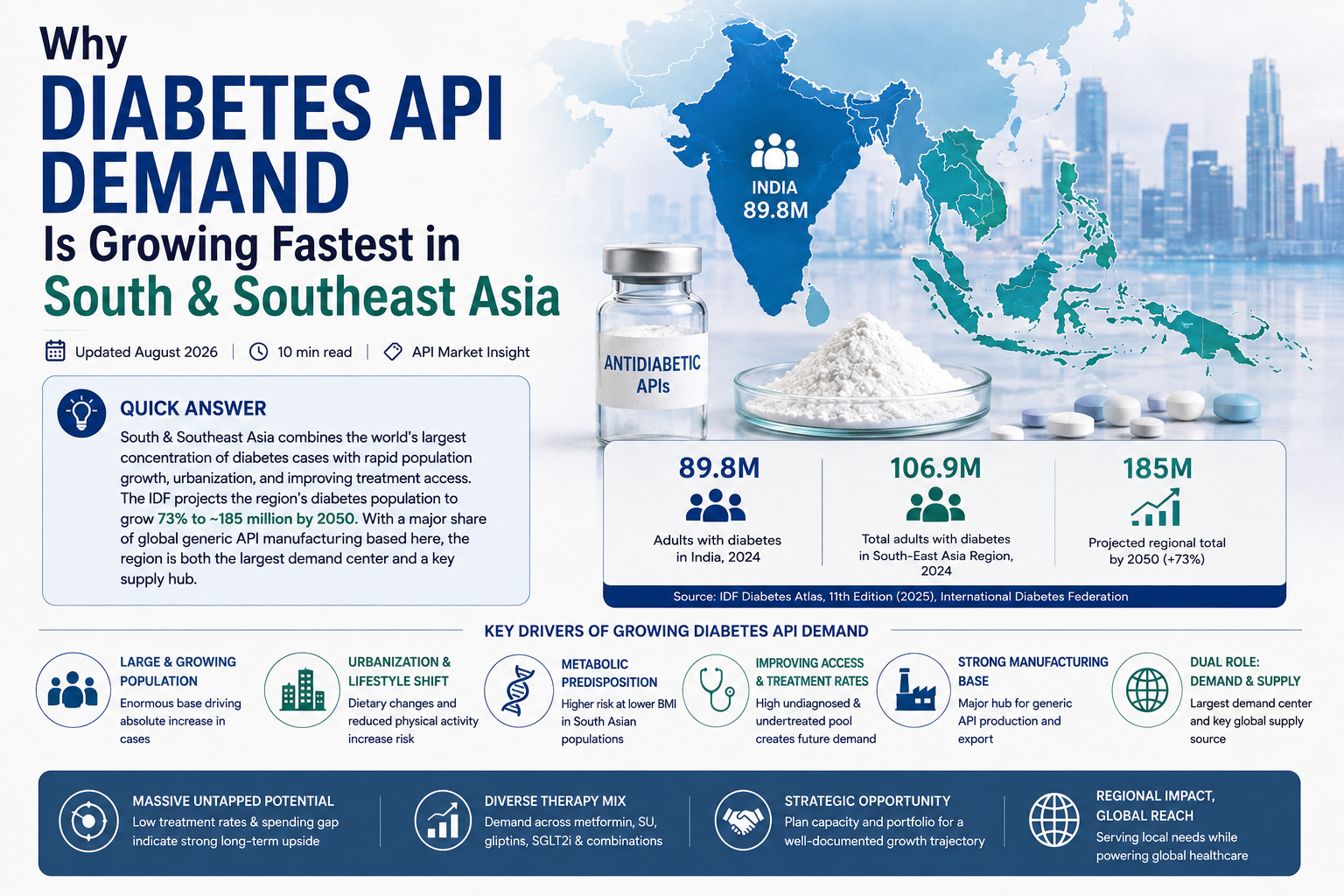
Diabetes API demand is growing fastest in South and Southeast Asia because the region combines the world’s largest concentration of diabetes cases with rapid population growth, urbanization, and improving diagnosis and treatment access. According to the IDF Diabetes Atlas 11th edition (2025), the IDF South-East Asia Region is projected to see its diabetes population grow 73% to roughly 185 million by 2050 — and India alone already accounts for over 80% of the region’s current cases. This is also the region where much of the world’s generic API manufacturing capacity is based, giving it a distinctive dual role as both the largest demand center and a primary supply source.
The Diabetes Burden and Why Diabetes API Demand Is Growing in South and Southeast Asia
According to the IDF Diabetes Atlas 11th edition (2025), published by the International Diabetes Federation, the scale of diabetes in this region is difficult to overstate. India alone had an estimated 89.8 million adults aged 20–79 living with diabetes in 2024 — the second-highest absolute number of any country in the world after China — and accounts for roughly 1 in 7 adults living with diabetes globally.
89.8M
Adults with diabetes in India, 2024
106.9M
Total adults with diabetes, IDF South-East Asia Region, 2024
185M
Projected regional total by 2050
Source: IDF Diabetes Atlas, 11th Edition (2025), International Diabetes Federation
India’s contribution to the regional burden is striking: its 89.8 million cases represent over 80% of the entire IDF South-East Asia Region’s total of 106.9 million. The IDF projects the region’s diabetes population will grow 73% to reach approximately 185 million by 2050, with regional prevalence rising from current levels to an estimated 13.2%. This isn’t a plateauing trend — it’s an accelerating one, and it sits at the center of why API demand originating from this region continues to climb.
Demographic and Lifestyle Factors Behind Rising Demand
Three overlapping factors explain why this region’s diabetes burden is growing faster than many others:
Population Scale
South and Southeast Asia collectively represent one of the largest population bases in the world. Even modest increases in prevalence translate into enormous absolute increases in patient numbers simply due to the size of the underlying population — a dynamic the IDF explicitly notes drives much of the global increase in diabetes cases in low- and middle-income countries generally.
Urbanization and Lifestyle Shift
The IDF Diabetes Atlas notes that global diabetes growth projections are linked in part to increasing urbanization, with the number of people with diabetes living in urban areas projected to rise substantially worldwide while rural numbers remain comparatively stable. South and Southeast Asia has experienced rapid urbanization in recent decades, a pattern widely associated in public health literature with dietary shifts toward processed foods and reduced physical activity — both established risk factors for type 2 diabetes.
Metabolic Predisposition
A substantial body of peer-reviewed research has documented that South Asian populations tend to develop insulin resistance and type 2 diabetes at lower body-mass-index thresholds than some other populations — sometimes referred to as the “thin-fat” phenotype in the epidemiological literature, characterized by higher visceral adiposity relative to overall BMI. This genetic and metabolic predisposition compounds the population-scale and lifestyle factors above, contributing to the region’s disproportionate share of global diabetes cases.
Healthcare Access and Treatment-Rate Growth
Rising prevalence alone doesn’t fully explain API demand growth — treatment rates matter just as much, and there’s meaningful room for growth here too. The IDF South-East Asia Region currently has the third-highest proportion of undiagnosed diabetes of any IDF region, at 42.7%, and separate peer-reviewed research on South Asia specifically estimates that almost half of adults living with diabetes in the region remain undiagnosed.
This matters directly for API demand: as diagnosis rates improve — through expanding healthcare access, government screening programs, and greater public health awareness — a large pool of currently undiagnosed and untreated patients becomes a source of future treatment demand, independent of any further rise in underlying prevalence. One study cited in regional research found that fewer than 1 in 4 people in India already on regular diabetes treatment had achieved adequate glycaemic control, pointing to substantial room for treatment intensification and multi-drug therapy — both of which increase per-patient API volume over time.
Notably, the IDF also reports that the South-East Asia Region receives only about USD 12 billion in total diabetes-related health expenditure — roughly 1% of the global total — despite the region accounting for an estimated 18.2% of people with diabetes worldwide. This spending gap underscores that current treatment rates likely understate the region’s true long-term demand potential as healthcare investment catches up to disease burden.
Why This Region Is Also Where Diabetes APIs Are Manufactured
What makes South and Southeast Asia unusual as a diabetes API market isn’t just the size of the demand — it’s that the region also hosts a large share of the world’s generic API manufacturing capacity, with India in particular established as one of the largest global sources of generic pharmaceutical ingredients across virtually every major therapeutic category, including antidiabetics.
This creates a distinctive dynamic rarely seen in other therapeutic areas: local manufacturing serving local demand directly, alongside substantial export capacity serving other regulated and semi-regulated markets. For API manufacturers, this dual role means regional strategy isn’t purely about export opportunity or purely about domestic market growth — it’s usually some blend of both, often within the same manufacturing footprint.
Which Antidiabetic API Classes Are Seeing the Strongest Regional Growth
Demand growth isn’t uniform across every antidiabetic drug class:
- Metformin and sulfonylureas remain foundational, first-line therapies across the region, and their low cost keeps them central to treatment protocols in markets where affordability is a major factor in prescribing decisions.
- Gliptins (DPP-4 inhibitors) have an established generic manufacturing base in the region already, as covered in our companion article on gliptin intermediates, and continue to see steady demand as a well-tolerated add-on therapy.
- SGLT2 inhibitors are seeing rising regional interest as more molecules in the class approach genericization, a trend explored further in our gliptin vs SGLT2 inhibitor demand comparison.
As treatment protocols increasingly favor combination therapy to hit glycaemic control targets — relevant given the low control rates noted earlier — demand growth is likely to favor manufacturers with capability across multiple classes rather than a single-molecule focus.
What This Means for Generic API Manufacturers
For manufacturers already based in or serving this region, the opportunity is less about discovering new demand and more about capacity planning against a well-documented, long-running growth trajectory — the IDF’s own projections through 2050 give a reasonably clear long-term demand signal to plan against.
For manufacturers outside the region evaluating entry, the calculus is different: local regulatory knowledge, government tender processes, and relationships with regional distributors matter significantly more here than in a market being approached purely for export volume. The size of the domestic market means regional-market dynamics — not just export economics — deserve real weight in any market-entry evaluation.
Frequently Asked Questions
Why does South and Southeast Asia have such high diabetes prevalence?
The region combines a very large population base with rising urbanization, dietary shifts, and a well-documented genetic and metabolic predisposition toward insulin resistance at lower body-mass-index thresholds than seen in some other populations, according to IDF Diabetes Atlas data and peer-reviewed epidemiological research.
Which countries in the region have the highest diabetes burden?
India carries by far the largest share, accounting for roughly 89.8 million of the IDF South-East Asia Region’s estimated 106.9 million adult diabetes cases in 2024 — over 80% of the regional total — and ranks second globally in absolute case numbers after China, according to the IDF Diabetes Atlas 11th edition.
Is India both a major diabetes market and a major API manufacturing hub?
Yes. India carries one of the world’s largest diabetes patient populations while simultaneously hosting one of the world’s largest generic API manufacturing bases, giving it a distinctive dual role as both demand center and supply source for antidiabetic APIs.
Which antidiabetic APIs are in highest demand in this region?
Established, low-cost classes such as metformin and sulfonylureas remain foundational given regional cost sensitivity, while gliptins have a long-established generic presence and SGLT2 inhibitors are seeing rising interest as more molecules in that class approach genericization.
Is diabetes API demand growth in this region expected to continue?
According to IDF projections, the number of adults with diabetes in the South-East Asia Region is expected to grow 73% to reach approximately 185 million by 2050, with regional prevalence rising to an estimated 13.2%, suggesting sustained long-term demand growth.
Conclusion — A Region Where Demand and Manufacturing Capability Converge
South and Southeast Asia’s position in the global diabetes API landscape isn’t accidental — it reflects a genuine convergence of factors: the world’s largest concentration of diabetes cases, a population and urbanization trajectory that points toward continued growth through 2050, meaningfully low current treatment and diagnosis rates with real room for improvement, and a manufacturing base already positioned to serve that demand. For API manufacturers, understanding this region means treating it as more than an export market — it’s a place where local demand dynamics, healthcare investment trends, and manufacturing strategy are unusually intertwined.
Building an antidiabetic API strategy for this region?
Explore our sourcing guides across gliptins, SGLT2 inhibitors, and acarbose manufacturing to inform your regional portfolio planning.