 Rajat Sharma
for Dapagliflozin Intermediate Sourcing – A practical guide to choosing between the two synthesis-stage intermediates commonly labeled DAPA-I and DAPA-II — what each one generally represents, and how to confirm you’re ordering the right one for your process.
📅 Updated August 2026 | ⏱ 9 min read | 🏷 Intermediate Sourcing
Quick Answer
DAPA-I generally refers to the early-stage aryl fragment used to build dapagliflozin’s aromatic core, while DAPA-II generally refers to the advanced-stage glycosylated intermediate, one or two steps from the finished API. If your process starts synthesis from the earliest practical point, you likely need DAPA-I; if your route picks up closer to final coupling and deprotection, you likely need DAPA-II. Either way, confirm the CAS number and structure behind whichever label your supplier uses — these are trade shorthand, not standardized names.
Quick Recap — in Dapagliflozin Intermediate Sourcing Why “DAPA-I” and “DAPA-II” Aren’t Standardized Names
A note on naming: As covered in our companion article on dapagliflozin’s synthesis, “DAPA-I” and “DAPA-II” are informal trade shorthand used by some suppliers — not CAS-registered chemical names. We could not locate a public chemical database or patent reference that consistently maps these exact codes to one specific structure. The same pattern shows up with other intermediates too, including the DPA/LRD/LRCII shorthand used in Lercanidipine sourcing.
This distinction matters more at the buying stage than at the learning stage. When you’re just researching dapagliflozin’s chemistry, the general concept of “early-stage” vs “advanced-stage” intermediate is enough. When you’re placing an order, the gap between a trade code and a verified CAS number is exactly where sourcing mistakes happen — ordering the wrong stage, the wrong purity grade, or a completely different compound that happened to share a supplier’s internal label.
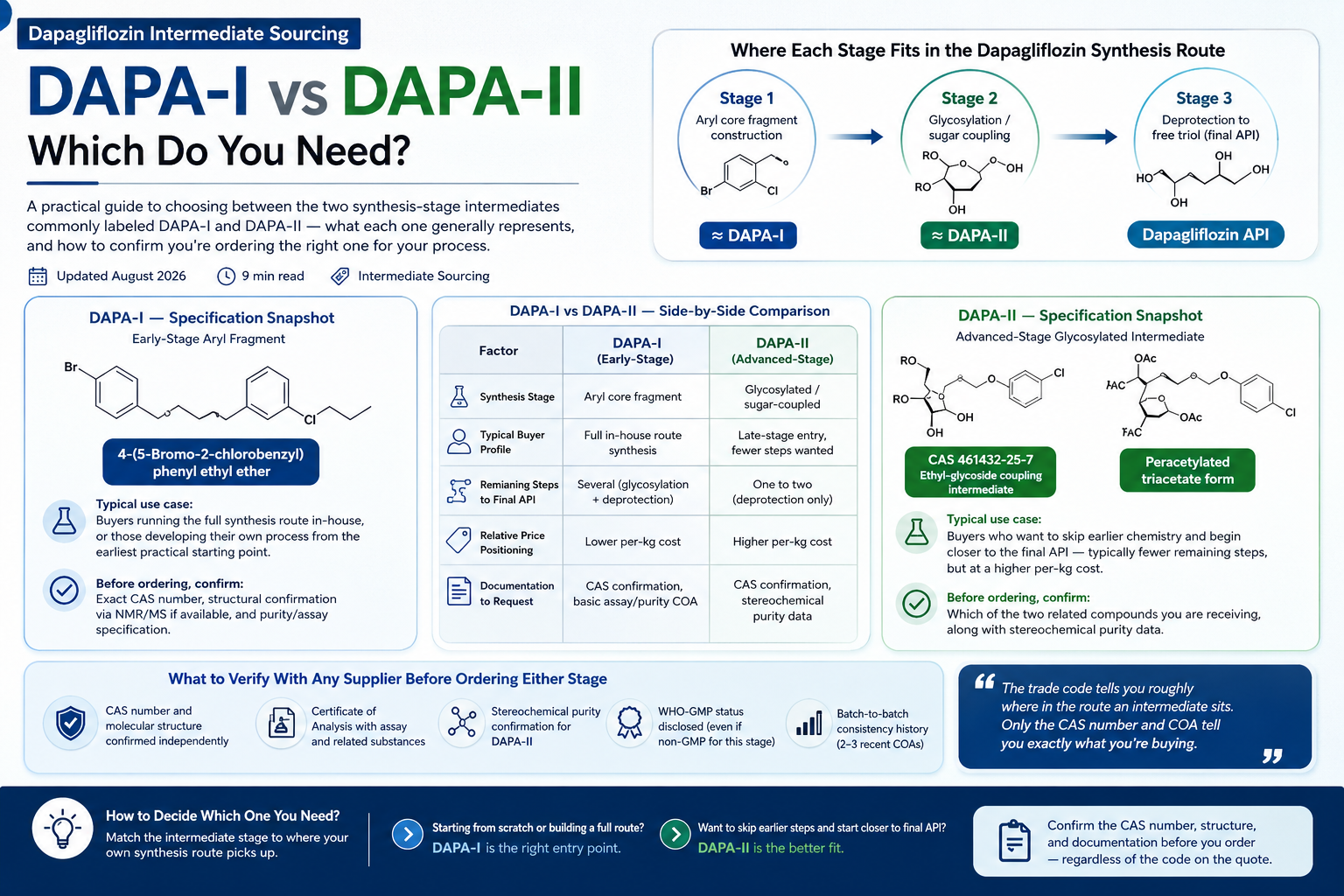
Where Each Stage Fits in the Dapagliflozin Synthesis Route
Dapagliflozin’s synthesis follows a three-stage pattern: build the aromatic core, couple it to a protected sugar unit, then deprotect to reveal the final triol.
Stage 1
Aryl core fragment construction
≈ DAPA-I
Stage 2
Glycosylation / sugar coupling
≈ DAPA-II
Stage 3
Deprotection to free triol (final API)
In practice, this means DAPA-I is typically offered to buyers who want to run more of the synthesis themselves, starting from an earlier point in the route. DAPA-II is typically offered to buyers who want to shortcut the earlier chemistry and begin closer to the finished molecule.
DAPA-I — Specification Snapshot
Early-Stage Aryl Fragment
Based on publicly documented patent literature and supplier catalogs, the compound most consistent with this stage is:
4-(5-Bromo-2-chlorobenzyl)phenyl ethyl ether
Typical use case: Buyers running the full synthesis route in-house, or those developing their own process from the earliest practical starting point. This stage requires the most remaining synthetic work but generally offers the most flexibility and lowest per-kilogram cost.
Before ordering under this label, confirm: exact CAS number, structural confirmation via NMR/MS if available, and purity/assay specification — since this fragment’s structure is relatively simple, a mismatch here is usually easy to catch with basic analytical testing.
DAPA-II — Specification Snapshot
Advanced-Stage Glycosylated Intermediate
Two related compounds appear consistently at this stage across supplier documentation:
CAS 461432-25-7 — the ethyl-glycoside coupling intermediate
Peracetylated triacetate form — a further downstream variant requiring only deacetylation
Typical use case: Buyers who want to skip the earlier aryl-fragment and glycosylation-coupling chemistry and begin closer to the final API — typically fewer remaining steps, but at a higher per-kilogram cost that reflects the additional processing already completed.
Before ordering under this label, confirm: which of the two related compounds above the supplier is actually quoting (ethyl-glycoside vs. peracetylated triacetate — these require different final steps), along with stereochemical purity data, since this stage sets the configuration carried through to the finished API.
DAPA-I vs DAPA-II — Side-by-Side Comparison
| Factor | DAPA-I (Early-Stage) | DAPA-II (Advanced-Stage) |
|---|---|---|
| Synthesis Stage | Aryl core fragment | Glycosylated / sugar-coupled |
| Typical Buyer Profile | Full in-house route synthesis | Late-stage entry, fewer steps wanted |
| Remaining Steps to Final API | Several (glycosylation + deprotection) | One to two (deprotection only) |
| Relative Price Positioning | Lower per-kg cost | Higher per-kg cost |
| Documentation to Request | CAS confirmation, basic assay/purity COA | CAS confirmation, stereochemical purity data |
How to Decide Which One You Actually Need
The decision comes down almost entirely to where your own synthesis route picks up:
- Ask: Does our process currently start from a basic aromatic building block, or do we already have capability to run the earlier steps and just need to skip to coupling?
- If starting from scratch or building a fully independent route, DAPA-I is the appropriate entry point.
- If your process is designed around the later coupling/deprotection chemistry — or you specifically want to reduce your own synthetic burden — DAPA-II is the better fit.
Buying the wrong stage doesn’t just waste the purchase cost — it can derail a route-development timeline. An early-stage fragment bought when your process was built around late-stage coupling means unplanned additional synthesis work; an advanced-stage intermediate bought when your team wanted to develop and control the full route means paying a premium for steps you didn’t need done for you.
What to Verify With Any Supplier Before Ordering Either Stage
Pre-Order Verification Checklist
- CAS number and molecular structure confirmed independently, not just the trade code
- Certificate of Analysis with assay and related-substances data
- Stereochemical purity confirmation for DAPA-II specifically, given its role in setting final API configuration
- WHO-GMP status disclosed, even if the material is non-GMP for this early stage
- Batch-to-batch consistency history — ask for two or three recent COAs, not just one
These same questions apply regardless of which stage you’re buying — see our companion guide on vetting a WHO-GMP intermediate supplier for a more detailed walkthrough of the full qualification process.
The trade code tells you roughly where in the route an intermediate sits. Only the CAS number and COA tell you exactly what you’re buying.
Frequently Asked Questions
What is the difference between DAPA-I and DAPA-II?
DAPA-I is trade shorthand generally used for the early-stage aryl fragment in dapagliflozin synthesis, while DAPA-II generally refers to the advanced-stage glycosylated intermediate, closer to the finished API. Neither term is standardized, so the exact compound behind each label should always be confirmed with the specific supplier.
Are DAPA-I and DAPA-II the same across every supplier?
Not necessarily. Because these are informal trade codes rather than CAS-registered names, different suppliers may apply them to different compounds or purity grades. Always confirm CAS number and molecular structure directly rather than assuming the label alone guarantees a specific compound.
Which dapagliflozin intermediate should I buy if I’m starting synthesis from scratch?
If your process begins at the earliest practical stage, the early-stage aryl fragment commonly labeled DAPA-I is the appropriate starting material. If your route is designed to begin closer to the final coupling and deprotection steps, the advanced-stage glycosylated intermediate commonly labeled DAPA-II is the better fit.
Do I need both DAPA-I and DAPA-II, or just one?
Most buyers need only one, depending on where their in-house process picks up. Sourcing both is only necessary if you’re evaluating multiple route options or qualifying more than one supplier across different synthesis stages.
How do I confirm the exact identity of a DAPA-I or DAPA-II intermediate before ordering?
Request the supplier’s CAS number, molecular formula, and structure for the specific batch, cross-check it against an independent chemical database, and request a Certificate of Analysis with related-substances data before placing a bulk order.
Conclusion — Choosing the Right Dapagliflozin Intermediate Stage
Choosing between DAPA-I and DAPA-II isn’t really about the labels — it’s about matching the intermediate stage to exactly where your own synthesis route picks up. Once you know that, the trade code becomes a useful shorthand for starting the conversation with a supplier, not a specification to rely on. Confirm the CAS number, structure, and documentation behind whichever stage you need before committing to an order, regardless of which code appears on the quotation.