 Rajat Sharma
A plain-language walkthrough of the chemical building blocks behind two leading direct oral anticoagulants — what they are, how they differ, and why intermediate quality matters in manufacturing.
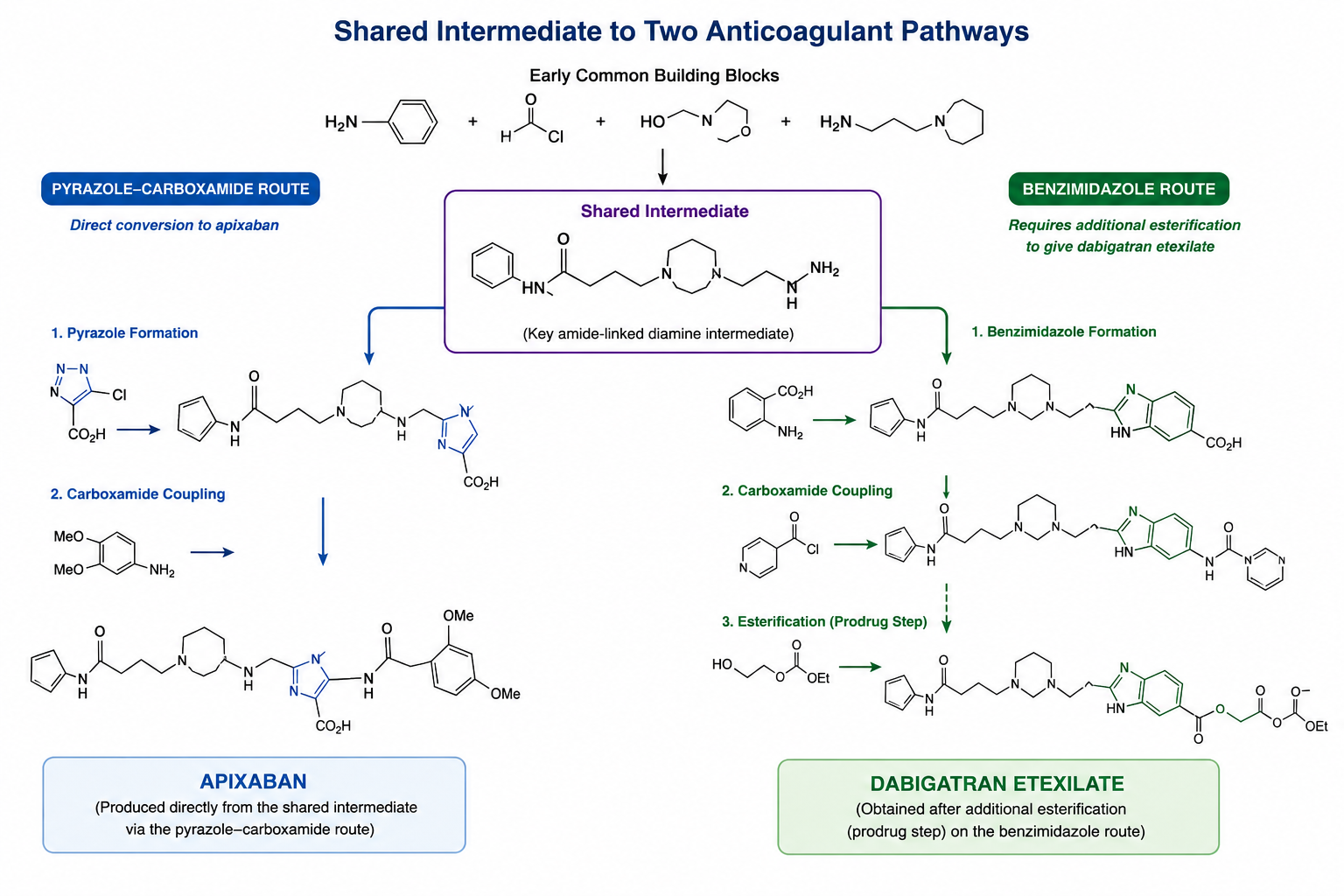
Anticoagulant Intermediate Chemistry are the intermediate chemical compounds used to synthesize direct oral anticoagulant (DOAC) active pharmaceutical ingredients, such as apixaban and dabigatran. Apixaban is built from a pyrazole-carboxamide core targeting Factor Xa, while dabigatran is built from a benzimidazole core targeting thrombin directly — and each pathway relies on distinct precursor chemistry that determines the final API’s purity, yield, and regulatory compliance.
In This Article
- What Are Direct Oral Anticoagulants (DOACs)?
- Understanding Pharmaceutical Intermediates
- Apixaban Intermediates
- Dabigatran Intermediates
- Comparing Apixaban & Dabigatran Intermediates
- Manufacturing Considerations
- Why Intermediate Selection Matters
- FAQs
What Are Direct Oral Anticoagulants (DOACs)?
Direct oral anticoagulants are a newer class of blood-thinning medications that act on specific clotting factors, offering an alternative to older agents like warfarin. They are widely prescribed for stroke prevention in atrial fibrillation and for treating or preventing venous thromboembolism.
How DOACs Differ From Older Anticoagulants Like Warfarin
Warfarin works indirectly by inhibiting vitamin K-dependent clotting factor synthesis in the liver, requiring regular blood monitoring. DOACs, by contrast, directly and selectively inhibit a single clotting factor, offering more predictable dosing without routine monitoring in most patients.
Factor Xa Inhibitors vs. Direct Thrombin Inhibitors
DOACs fall into two mechanistic subclasses. Factor Xa inhibitors, such as apixaban, block the enzyme Factor Xa upstream in the coagulation cascade. Direct thrombin inhibitors, such as dabigatran, act further downstream by directly blocking thrombin, the enzyme responsible for converting fibrinogen into fibrin clots.
Common DOACs on the Market
Beyond apixaban and dabigatran, the DOAC category includes rivaroxaban and edoxaban, both Factor Xa inhibitors with structurally distinct cores from apixaban. This article focuses on apixaban and dabigatran because their intermediate chemistry illustrates two fundamentally different synthesis philosophies within the same drug class.
Understanding Pharmaceutical Intermediates in Anticoagulant Synthesis
Before comparing apixaban and dabigatran directly, it helps to understand where intermediates fit into anticoagulant API manufacturing.
Raw Materials vs. Intermediates vs. Final API
Raw materials are the basic starting chemicals sourced from suppliers. Intermediates are partially built compounds generated at each stage of synthesis — structurally closer to the target molecule but not yet pharmacologically active on their own. The active pharmaceutical ingredient (API) is the finished compound formulated into the marketed drug product.
Why Multi-Step Synthesis Is Standard for Complex Anticoagulant Molecules
Both apixaban and dabigatran require several discrete synthesis stages — ring construction, fragment coupling, and in dabigatran’s case, prodrug esterification — because their target-specific functional groups cannot be assembled in a single reaction step without compromising yield or purity.
How Intermediate Purity Affects Final API Safety and Yield
Impurities carried over from early intermediates are often difficult to remove in later purification stages, and regulatory agencies set strict impurity thresholds for anticoagulant APIs given their narrow therapeutic considerations. Manufacturers that control purity at the intermediate stage typically achieve more consistent yield and smoother regulatory filings.
Apixaban Intermediates
Apixaban’s synthesis is built around a fused pyrazole-lactam scaffold that is assembled and functionalized in stages.
Core Building Blocks
Apixaban’s key intermediates include a pyrazole-carboxamide core, a para-methoxyphenyl (PMP) substituent, and a fused lactam ring. The lactam ring formation is one of the more structurally distinctive steps in apixaban’s synthesis compared to other Factor Xa inhibitors.
Simplified Synthesis Pathway Overview
- Construction of the pyrazole ring bearing the carboxamide and PMP substituents
- Cyclization to form the fused lactam ring system
- Introduction of the primary carboxamide functional group
- Final purification and crystallization to yield apixaban
Key Industrially Referenced Intermediates
Process documentation commonly references the PMP-substituted pyrazole ester intermediate and the lactam-fused pyrazole carboxylic acid, both precursors to the final carboxamide-bearing apixaban molecule.
Dabigatran Intermediates
Dabigatran’s synthesis differs meaningfully from apixaban’s because its active form requires prodrug conversion for oral use.
Core Building Blocks
Dabigatran’s key intermediates include a benzimidazole core, a pyridine carboxylic acid fragment, and an amidine functional group that is essential for thrombin binding. The amidine group’s strong polarity is central to dabigatran’s mechanism but also limits the parent compound’s oral absorption.
Role of the Etexilate Prodrug Ester
Because the free amidine form of dabigatran is poorly absorbed orally, manufacturers introduce a double-ester side chain — the etexilate group — during synthesis. This prodrug ester improves gastrointestinal absorption; the ester bonds are then cleaved in the body to release active dabigatran.
Key Synthesis Stages and Referenced Intermediates
- Construction of the benzimidazole core bearing the amine substituent
- Coupling with the pyridine carboxylic acid fragment
- Formation of the amidine group through cyanamide-based cyclization chemistry
- Esterification with the hexyloxycarbonyl etexilate side chain
- Final purification to yield dabigatran etexilate mesylate
Quick Comparison Note
Apixaban is administered in its active form directly, while dabigatran must first be converted from its etexilate prodrug form after oral intake — a distinction that originates entirely at the intermediate synthesis stage.
Comparing Apixaban and Dabigatran Intermediate Chemistry
| Feature | Apixaban | Apixaban |
|---|---|---|
| Core ring system | Pyrazole-lactam fused scaffold | Benzimidazole core |
| Key functional group | Carboxamide | Amidine |
| Molecular target | Factor Xa (upstream cascade) | Thrombin (downstream cascade) |
| Prodrug required? | No | Yes (etexilate ester) |
| Relative synthesis complexity | Moderate | Higher (extra esterification stage) |
| Administered form | Active compound | Dabigatran etexilate mesylate |
Structural Differences Reflecting Different Drug Targets
Because apixaban and dabigatran inhibit different points in the coagulation cascade, their core scaffolds share no direct structural overlap — unlike same-class drugs within the ARB or statin families, which often share a common backbone.
Why Dabigatran Needs a Prodrug Step and Apixaban Doesn’t
Dabigatran’s amidine group is essential for thrombin binding but makes the free-base molecule too polar for efficient oral absorption, necessitating the etexilate ester step. Apixaban’s carboxamide-based core does not carry the same absorption limitation, allowing it to be manufactured and administered without an additional prodrug stage.
Manufacturing Considerations for Anticoagulant Intermediates
Regulatory & Quality Standards
Anticoagulant intermediate manufacturers maintain Drug Master Files (DMFs) and follow Good Manufacturing Practice (GMP) frameworks aligned with ICH guidelines. Documentation typically includes certificates of analysis, validated impurity profiles, and analytical methods referencing pharmacopeial monographs.
Handling Reactive or Sensitive Intermediates
Certain stages — such as amidine formation in dabigatran synthesis or lactam cyclization in apixaban synthesis — involve reactive intermediates that require tightly controlled reaction conditions to avoid side-product formation and to maintain batch consistency.
Scalability and Cost Factors in Bulk Production
Dabigatran’s additional esterification stage generally increases per-kilogram production costs relative to apixaban, since each additional synthesis step introduces further yield loss and purification requirements at scale.
Why Intermediate Selection Matters for Pharma Manufacturers
Impact on Yield, Purity & Impurity Control
Choosing intermediates with well-documented impurity profiles reduces downstream purification burden, which directly affects overall API yield, batch consistency, and regulatory filing timelines for anticoagulant products.
Supply Chain Reliability for Critical Anticoagulant Intermediates
Because both apixaban and dabigatran depend on a limited number of specialized intermediates, manufacturers often qualify multiple suppliers for each critical fragment to reduce single-source risk and protect continuous production.
Frequently Asked Questions
What is an anticoagulant intermediate?
An anticoagulant intermediate is a chemical compound produced during the multi-step synthesis of an anticoagulant API, such as apixaban or dabigatran. It is not the final drug substance, but a building block that undergoes further reaction, cyclization, or esterification to form the active pharmaceutical ingredient.
What are the key intermediates used in apixaban synthesis?
Apixaban synthesis relies on a pyrazole-carboxamide core intermediate combined with a para-methoxyphenyl fragment and a lactam ring precursor, coupled and cyclized in sequence to build the finished molecule.
How is dabigatran etexilate synthesized?
Dabigatran etexilate is built from a benzimidazole core intermediate joined with a pyridine carboxylic acid fragment, followed by amidine formation and esterification with the etexilate side chain to create the oral prodrug.
Why does dabigatran require a prodrug form but apixaban doesn’t?
Dabigatran’s active form carries a strongly polar amidine group that limits oral absorption, so it is administered as dabigatran etexilate, a double-ester prodrug that improves gut absorption before conversion to the active drug in the body. Apixaban’s core structure already has sufficient oral bioavailability without requiring a prodrug ester.
Where can pharmaceutical companies source high-quality anticoagulant intermediates?
Manufacturers typically source anticoagulant intermediates from GMP-certified custom synthesis and API intermediate suppliers that provide documented DMFs, certificates of analysis, and consistent batch-to-batch purity.
Follow us on Instagram : rokadoverseas