 Rajat Sharma
A plain-language walkthrough of the chemical building blocks behind three major angiotensin receptor blockers — what they are, how they differ, and why they matter to pharmaceutical manufacturing.
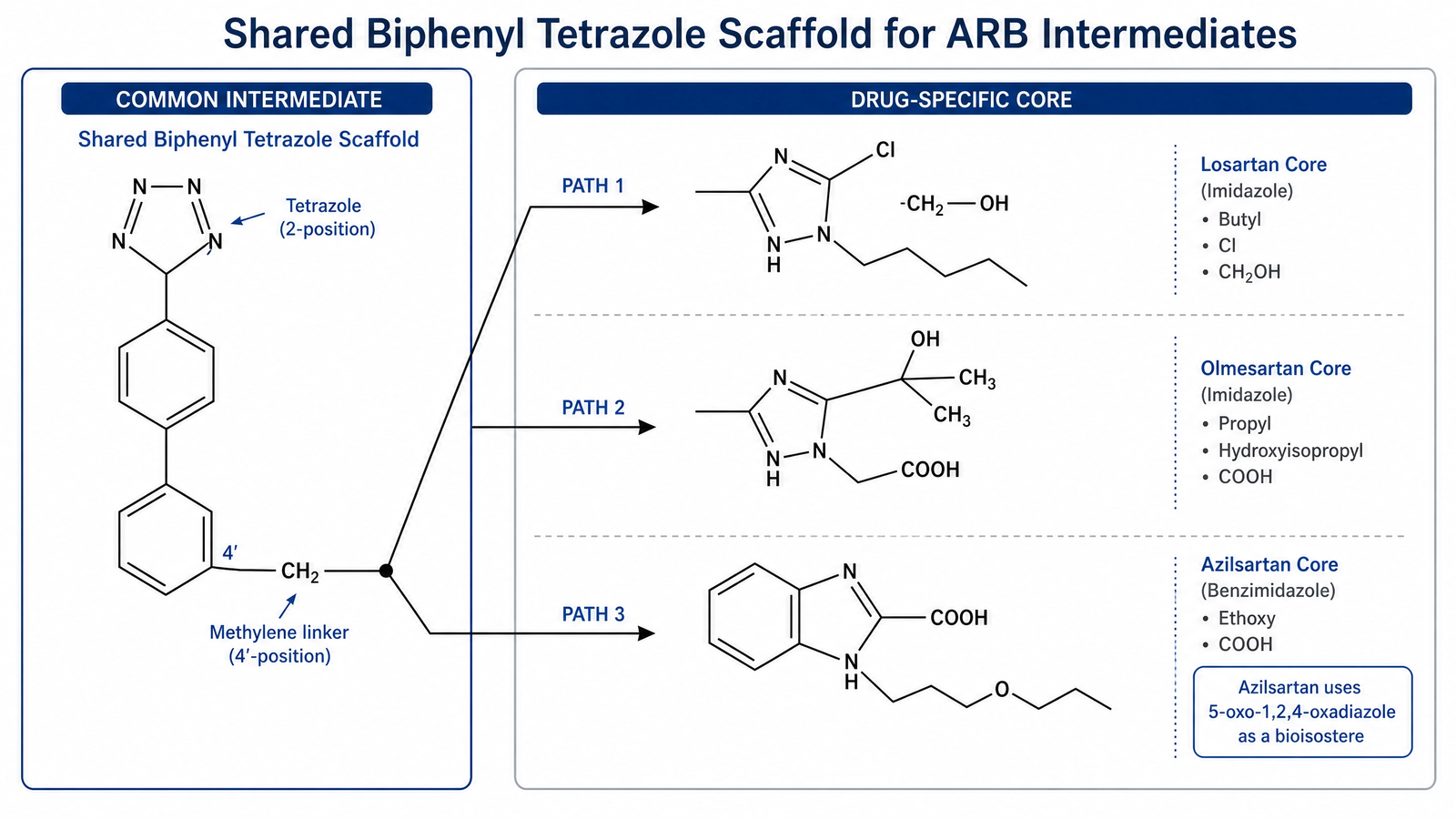
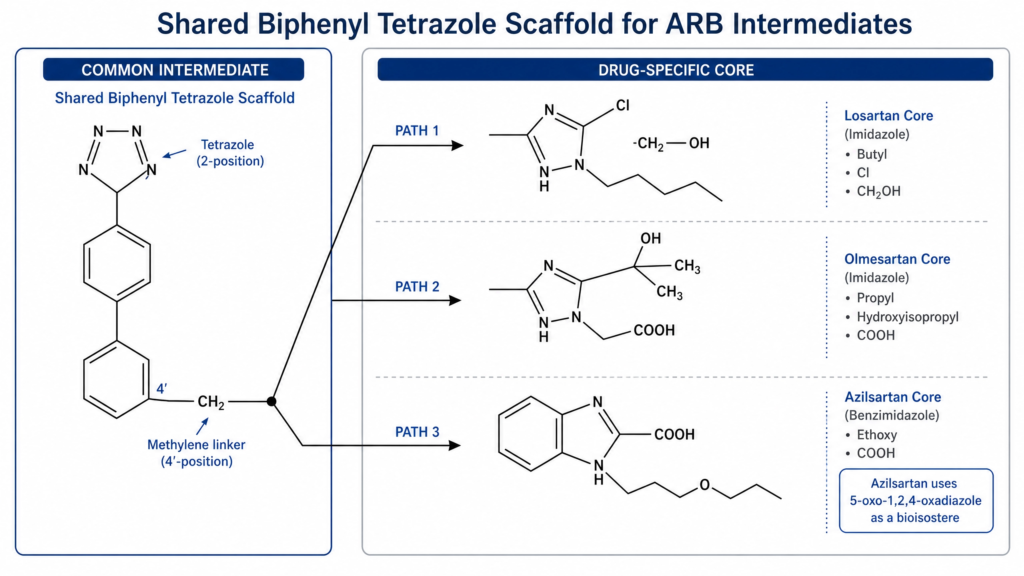
ARB intermediates are the intermediate chemical compounds used to synthesize angiotensin receptor blocker (ARB) active pharmaceutical ingredients, such as losartan, olmesartan, and azilsartan. Each ARB is assembled from a shared biphenyl tetrazole scaffold combined with a drug-specific heterocyclic core, and the quality of these intermediates directly determines the purity, yield, and regulatory compliance of the final API.
In This Article
- What Are Angiotensin Receptor Blockers?
- Understanding Pharmaceutical Intermediates
- Losartan Intermediates
- Olmesartan Intermediates
- Azilsartan Intermediates
- Comparing the Three Sartans
- Manufacturing Considerations
- Why Intermediate Selection Matters
- FAQs
What Are Angiotensin Receptor Blockers (ARBs)?
Angiotensin receptor blockers are a class of antihypertensive drugs that block the AT1 receptor, preventing angiotensin II from constricting blood vessels. By interrupting this pathway, ARBs help lower blood pressure and are widely prescribed for hypertension, heart failure, and chronic kidney disease management.
How ARBs Work in the Body
Angiotensin II is a hormone that binds to AT1 receptors on blood vessel walls, triggering vasoconstriction and sodium retention. ARBs are structurally designed to occupy this receptor site instead, blocking angiotensin II from binding and allowing blood vessels to relax.
Common ARB Drugs on the Market
The sartan family includes several widely manufactured drugs: losartan, olmesartan, azilsartan, valsartan, telmisartan, candesartan, and irbesartan. While each has a distinct chemical identity, most share a common biphenyl tetrazole backbone — a structural signature of the entire ARB class. This article focuses on losartan, olmesartan, and azilsartan, three sartans with notably different intermediate chemistry and synthesis complexity.
Understanding Pharmaceutical Intermediates
Before diving into individual ARBs, it helps to understand where intermediates fit in the drug manufacturing process.
Difference Between Intermediates, APIs & Raw Materials
Raw materials are the basic starting chemicals purchased from suppliers. Intermediates are the partially reacted compounds created during synthesis — not yet biologically active, but structurally closer to the final molecule. The active pharmaceutical ingredient (API) is the finished, pharmacologically active compound that goes into a formulated drug product.
Role of Intermediates in Sartan Drug Synthesis
Sartan APIs are typically built in multiple stages, with each stage producing a distinct intermediate. A biphenyl tetrazole intermediate is coupled to a heterocyclic core intermediate (imidazole, benzimidazole, or oxadiazolone depending on the drug), and further functional groups are added or modified before the final API is isolated and purified.
Why Intermediate Quality Impacts Final API Purity
Impurities introduced at the intermediate stage tend to carry through the rest of the synthesis, often becoming difficult or costly to remove later. Manufacturers that control intermediate purity early in the process typically see higher API yield, fewer purification cycles, and more consistent compliance with pharmacopeial impurity limits.
Losartan Intermediates
Losartan, one of the earliest ARBs developed, relies on a well-established two-fragment synthesis route.
Key Building Blocks
Losartan’s synthesis combines a biphenyl tetrazole intermediate with an imidazole core bearing a chlorine substituent, a hydroxymethyl group, and an n-butyl chain. The n-butyl group is a defining structural feature that contributes to receptor binding affinity.
Simplified Synthesis Pathway Overview
- Construction of the imidazole ring bearing chloro, hydroxymethyl, and butyl substituents
- Preparation of the biphenyl tetrazole fragment, often via a protected tetrazole route
- Coupling of the two fragments through N-alkylation
- Deprotection and purification to yield losartan, typically isolated as losartan potassium
Common Industrially Used Intermediates
Industrial batches commonly reference intermediates such as the chlorinated hydroxymethyl imidazole precursor and the trityl-protected biphenyl tetrazole fragment, which protects the reactive tetrazole nitrogen during earlier synthetic steps.
Olmesartan Intermediates
Olmesartan medoxomil builds on the same biphenyl tetrazole logic but introduces a prodrug ester designed to improve oral absorption.
Core Structural Building Blocks
The two central intermediates are an imidazole-carboxylic acid core substituted with hydroxyl and propyl groups, and the same biphenyl tetrazole fragment used across the sartan family. A separate medoxomil (cyclic carbonate ester) intermediate is prepared to convert the carboxylic acid into its prodrug form.
Key Synthesis Stages
- Formation of the substituted imidazole carboxylic acid core
- Coupling with the biphenyl tetrazole fragment
- Esterification with the medoxomil group to form the prodrug ester
- Final purification and crystallization to yield olmesartan medoxomil
Notable Intermediate Compounds
The hydroxypropyl imidazole dicarboxylate and the 5-methyl-1,3-dioxol-2-one (medoxomil) fragment are two intermediates frequently referenced in olmesartan process documentation, as they define both the pharmacophore and the prodrug’s absorption profile.
Quick Comparison Note
Unlike losartan, which is administered as the active acid form directly, olmesartan requires prodrug conversion in the gut — a structural distinction that begins at the intermediate stage with the medoxomil ester.
Azilsartan Intermediates
Azilsartan is a newer-generation ARB, and its intermediate chemistry reflects a structural departure from losartan and olmesartan.
Oxadiazolone Ring Building Block Explained
Rather than relying solely on a carboxylic acid or ester group, azilsartan’s core intermediate incorporates a 5-oxo-1,2,4-oxadiazole (oxadiazolone) ring fused to the imidazole scaffold. This ring system is believed to contribute to azilsartan’s comparatively strong and sustained AT1 receptor binding.
Synthesis Pathway Overview
- Construction of the imidazole-carboxylic acid intermediate, similar in early steps to olmesartan’s route
- Cyclization to form the oxadiazolone ring
- Coupling with the biphenyl tetrazole fragment
- Formation of the medoxomil prodrug ester to produce azilsartan medoxomil
Key Intermediate Compounds Used
Documented intermediates include the oxadiazolone-fused imidazole carboxylate and the corresponding biphenyl tetrazole coupling fragment, both of which require more controlled cyclization conditions than the earlier sartans.
Comparing Losartan, Olmesartan & Azilsartan Intermediates
| Feature | Losartan | Olmesartan | Azilsartan |
|---|---|---|---|
| Core ring system | Substituted imidazole | Imidazole carboxylic acid | Oxadiazolone-fused imidazole |
| Key functional group | Hydroxymethyl / butyl chain | Medoxomil prodrug ester | Oxadiazolone ring + medoxomil ester |
| Shared fragment | Biphenyl tetrazole | Biphenyl tetrazole | Biphenyl tetrazole |
| Relative synthesis complexity | Lower | Moderate | Higher |
| Administered form | Active acid (potassium salt) | Prodrug ester | Prodrug ester |
Structural Similarities Across the Sartan Family
All three drugs depend on the same biphenyl tetrazole intermediate as their AT1 receptor-binding anchor. This shared fragment is one reason many manufacturers producing one sartan intermediate are structurally positioned to produce others in the same family.
What Sets Azilsartan Intermediates Apart
Azilsartan’s oxadiazolone ring requires an additional cyclization step not present in losartan or olmesartan synthesis, which generally increases process complexity, reaction control requirements, and production cost per batch.
Manufacturing Considerations for ARB Intermediates
Regulatory & Quality Standards
Reputable intermediate manufacturers maintain Drug Master Files (DMFs) and comply with Good Manufacturing Practice (GMP) frameworks. Documentation typically includes certificates of analysis, impurity profiles, and validated analytical methods referencing pharmacopeial standards.
Sourcing Intermediates From Certified Manufacturers
API manufacturers generally vet intermediate suppliers based on regulatory filing history, batch consistency, and audit readiness, since intermediate quality directly affects downstream API approval timelines.
Scalability & Cost Factors in Bulk Production
Intermediates with more synthesis steps, such as azilsartan’s oxadiazolone-fused core, typically carry higher per-kilogram production costs than simpler intermediates like those used in losartan, due to additional reaction stages, purification cycles, and yield losses at each step.
Why Intermediate Selection Matters for Pharma Manufacturers
Impact on Yield and Purity
Choosing intermediates with well-controlled impurity profiles reduces the burden on downstream purification, which can materially affect overall API yield and production cost.
Supply Chain & Reliability Considerations
Because sartan APIs depend on a small number of critical intermediates, manufacturers often qualify multiple suppliers for the same intermediate to reduce single-source risk and protect production continuity.
Frequently Asked Questions
What is an ARB intermediate?
An ARB intermediate is a chemical compound produced during the multi-step synthesis of an angiotensin receptor blocker API. It is not the final drug substance, but a building block that is further reacted, purified, or modified to yield the active pharmaceutical ingredient.
What is the main intermediate used in losartan synthesis?
Losartan synthesis centers on a biphenyl tetrazole intermediate coupled with a chlorinated, hydroxymethyl-substituted imidazole core bearing an n-butyl chain.
How is olmesartan medoxomil synthesized?
Olmesartan medoxomil is built by coupling an imidazole-carboxylic acid intermediate with a biphenyl tetrazole fragment, then esterifying the product with a medoxomil group to form the oral prodrug.
What makes azilsartan intermediates unique?
Azilsartan intermediates feature an oxadiazolone ring fused to the imidazole core, a structural difference from losartan and olmesartan that is associated with stronger AT1 receptor binding.
Where can pharmaceutical companies source high-quality ARB intermediates?
Manufacturers typically source ARB intermediates from GMP-certified custom synthesis and API intermediate suppliers that provide documented DMFs, certificates of analysis, and consistent batch-to-batch purity.
Follow us on Instagram : rokadoverseas