 Rajat Sharma
A clear breakdown of what WHO-GMP for cardiovascular APIs covers, where the gap between WHO-GMP and EU-GMP matters most, and how to decide the right sourcing strategy for your cardiovascular API requirements.
Short answer: WHO-GMP for cardiovascular APIs can be sufficient sourcing in non-stringent markets and WHO-prequalification programs, but it is generally not sufficient on its own for EU market entry or for partnering with formulators regulated by stringent regulatory authorities (SRAs). Because cardiovascular APIs are often taken chronically at high volume and have a documented history of impurity-related recalls, most procurement and QA teams treat EU-GMP — or an equivalent stringent standard — as the safer baseline, even where it isn’t strictly mandated.
In This Article
- What Is WHO-GMP for cardiovascular APIs certification?
- What Is EU-GMP Certification?
- Key Differences Between WHO-GMP and EU-GMP
- Why Cardiovascular APIs Warrant Extra Scrutiny
- Is WHO-GMP Sufficient for Cardiovascular API Sourcing?
- How to Evaluate a Supplier Beyond Certification Labels
- FAQs
What Is WHO-GMP Certification?
WHO-GMP (World Health Organization Good Manufacturing Practice) is a globally recognized quality framework designed to ensure pharmaceutical products, including APIs, are consistently produced and controlled to appropriate quality standards.
Who Issues WHO-GMP for cardiovascular APIs and What It Verifies
WHO-GMP for cardiovascular APIs compliance is typically assessed by national drug regulatory authorities applying WHO guidelines, or directly through the WHO Prequalification of Medicines Programme for manufacturers supplying medicines for procurement by UN agencies and similar bodies. It verifies that a facility follows documented manufacturing procedures, quality control testing, and basic traceability practices.
Scope and Depth of WHO-GMP Inspections
WHO-GMP inspections cover core manufacturing controls — facility hygiene, equipment qualification, batch documentation, and quality control testing — but generally apply a less intensive data integrity and audit-trail review than inspections conducted by stringent regulatory authorities.
Countries/Markets That Accept WHO-GMP as Sufficient
WHO-GMP is widely accepted across many low- and middle-income markets, particularly where national regulatory capacity relies on WHO prequalification for procurement decisions, including large-scale public health programs for essential medicines.
What Is EU-GMP Certification?
EU-GMP is the Good Manufacturing Practice standard enforced within the European Union, applied to both finished dosage forms and active pharmaceutical ingredients intended for the EU market.
Who Issues EU-GMP (EMA / National Competent Authorities)
EU-GMP certificates are issued following inspections conducted by national competent authorities of EU member states, with oversight coordinated through the European Medicines Agency (EMA) and recorded in the EudraGMDP database.
Scope and Depth of EU-GMP Inspections
EU-GMP inspections apply detailed scrutiny to data integrity, computerized system validation, deviation management, and change control, in addition to the core manufacturing and quality control elements covered by WHO-GMP. Inspection reports are generally more granular and documentation expectations are stricter.
Markets and Regulatory Pathways That Require EU-GMP
APIs imported into the EU generally require EU-GMP compliance, or written confirmation of equivalent standards from the exporting country’s authority under the EU’s equivalence framework. Many stringent regulatory authorities (SRAs) outside the EU also treat EU-GMP compliance as a strong quality signal during their own supplier qualification processes.
Key Differences Between WHO-GMP and EU-GMP
| Feature | WHO-GMP | EU-GMP |
|---|---|---|
| Issuing body | National authority / WHO Prequalification Programme | EU national competent authorities, coordinated via EMA |
| Inspection rigor | Moderate; core GMP elements | High; includes deep data integrity review |
| Data integrity requirements | Basic documentation controls | Detailed audit trails, computerized system validation |
| Documentation depth | Standard batch records | Extensive, includes deviation & CAPA tracking detail |
| Global recognition | Broad in non-SRA markets | Recognized by most stringent regulatory authorities |
| Typical cost / timeline | Lower cost, shorter inspection cycle | Higher cost, longer inspection and remediation cycle |
Data Integrity & Audit Trail Expectations
EU-GMP inspectors typically expect fully validated computerized systems with complete audit trails covering who changed what data and when, whereas WHO-GMP inspections focus more on whether documented procedures exist and are generally followed.
Inspection Frequency and Follow-Up Requirements
EU-GMP facilities are subject to periodic re-inspection and are expected to close observations within defined timelines, with follow-up inspections triggered by significant findings. WHO-GMP follow-up cadence varies more by the issuing national authority’s own inspection capacity.
Recognition by Stringent Regulatory Authorities (SRAs)
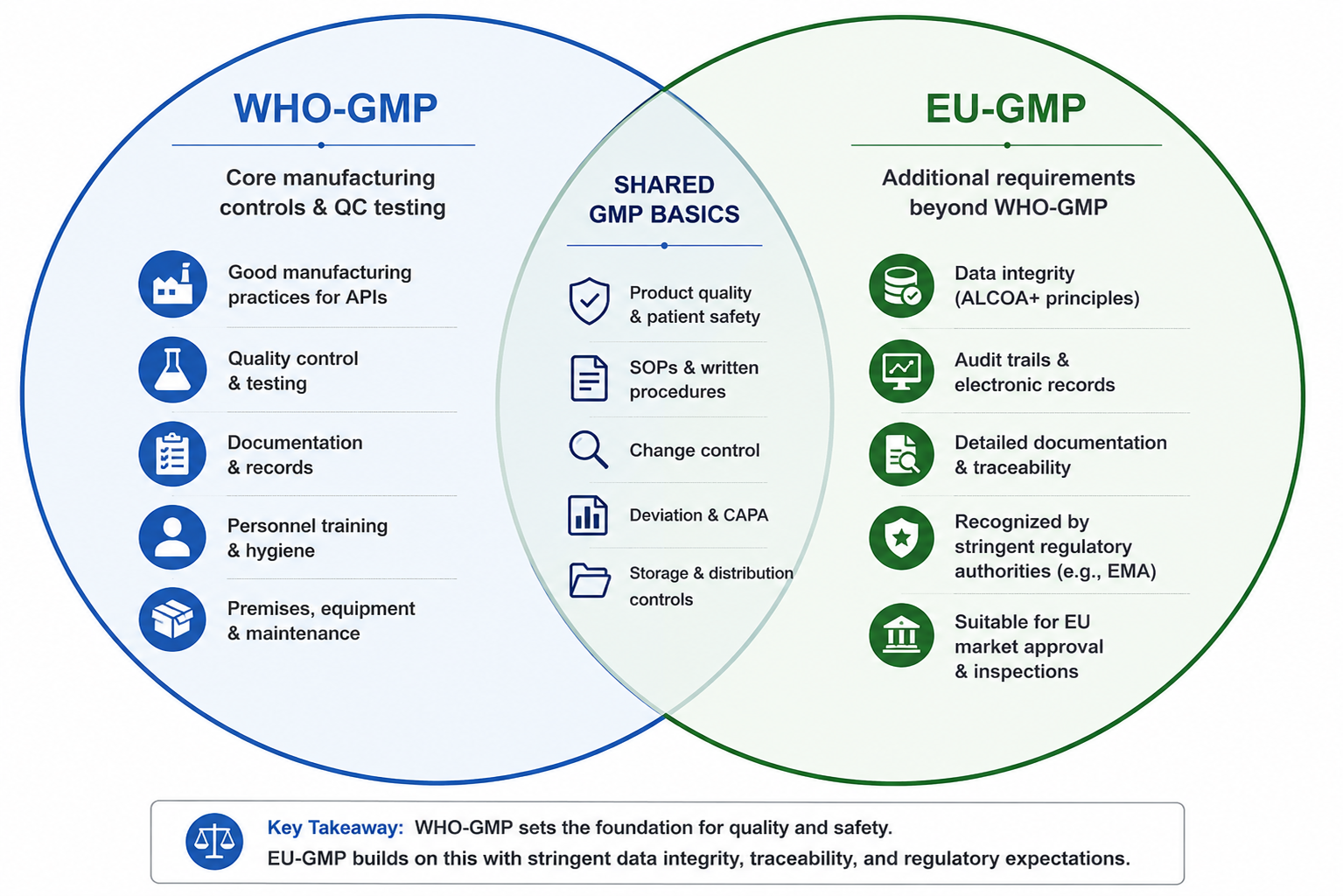
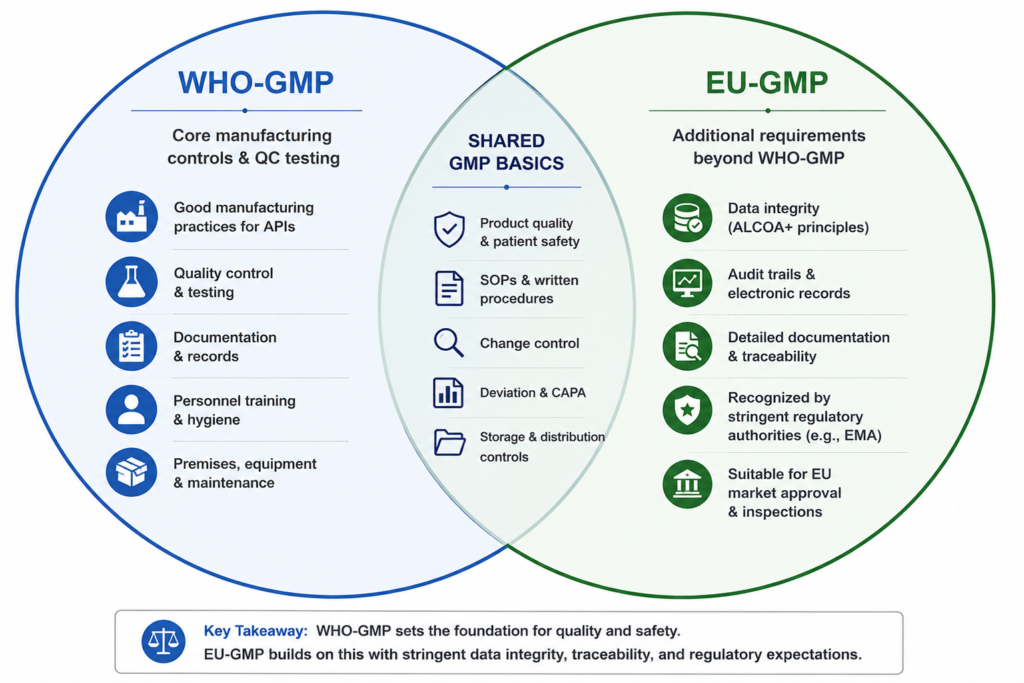
EU-GMP is broadly recognized as equivalent by other SRAs (such as those in the US, UK, Japan, and Australia) as part of mutual recognition agreements, while WHO-GMP alone is not automatically treated as equivalent to SRA-level inspection outcomes. WHO-GMP Core manufacturing controls & QC testing EU-GMP Data integrity, SRA recognition Shared GMP basics
Why Cardiovascular APIs Warrant Extra Scrutiny
Cardiovascular APIs are not governed by a separate regulatory standard, but several characteristics of this drug class make certification-level assurance especially important.
Narrow Therapeutic Index & Impurity Sensitivity
Many cardiovascular drug classes require tight control over process-related and degradation impurities, including genotoxic impurities and, more recently, nitrosamine limits, since even trace-level contamination can carry outsized regulatory and safety consequences at the doses and durations these drugs are used.
High-Volume, Long-Term Chronic Dosing Implications
Cardiovascular medications such as ARBs, statins, and anticoagulants are frequently taken daily for years or decades, which means small impurity levels considered acceptable for short-term use can accumulate to a clinically meaningful exposure over a patient’s lifetime.
Regulatory History of Cardiovascular API Recalls
The global valsartan recalls beginning in 2018, triggered by the detection of NDMA and related nitrosamine impurities in multiple sartan APIs, remain a widely referenced case study in why impurity control and manufacturing transparency matter disproportionately for cardiovascular APIs. That episode prompted expanded nitrosamine testing requirements from regulators including the EMA and FDA.
Is WHO-GMP Sufficient for Cardiovascular API Sourcing?
The honest answer depends heavily on your target market, your downstream customer’s regulatory pathway, and your organization’s risk tolerance.
Scenarios Where WHO-GMP Alone May Be Adequate
- Domestic sourcing for markets that accept WHO-GMP as the national baseline standard
- Supplying WHO-prequalified procurement programs where WHO-GMP is the recognized benchmark
- Non-SRA markets where local regulatory authorities do not mandate EU-GMP or equivalent
Scenarios Where EU-GMP (or Equivalent) Becomes Necessary
- Direct or indirect entry into the EU market, where EU-GMP or documented equivalence is generally required
- Partnering with formulators or distributors regulated by stringent regulatory authorities that expect EU-GMP-level documentation
- Responding to tenders or contracts that explicitly specify EU-GMP or SRA-equivalent certification as a qualifying criterion
Risk-Based Decision Framework for Procurement/QA Teams
A practical approach is to map the intended market’s regulatory requirements first, then assess the specific cardiovascular molecule’s known impurity risk profile, and finally weigh the cost and timeline trade-offs of requiring EU-GMP against the downside risk of a compliance gap surfacing later in the supply chain.
Quick Take
WHO-GMP for cardiovascular APIs is not automatically “insufficient” — it depends entirely on where the API is going and how it will be used downstream. For EU-bound cardiovascular APIs specifically, EU-GMP (or documented equivalence) is generally the safer default.
How to Evaluate an API Supplier Beyond Certification Labels
Certification status is a useful starting filter, but it shouldn’t be the only factor in a sourcing decision.
Reviewing DMFs, CEPs & Regulatory Filings
Requesting a supplier’s active Drug Master File (DMF) status or Certificate of Suitability (CEP) from the European Pharmacopoeia gives visibility into whether the API’s manufacturing process and impurity profile have already been reviewed by a regulatory body, independent of the GMP certificate itself.
On-Site Audits and Third-Party Quality Assessments
Independent audits — whether conducted directly or through a third-party quality assessment firm — can surface practical gaps between what a certificate states and what current manufacturing practice actually looks like on the floor.
Impurity Profiling and Stability Data Specific to Cardiovascular Molecules
For cardiovascular APIs in particular, reviewing molecule-specific impurity data (including nitrosamine testing where applicable) and stability studies gives a more direct picture of quality risk than certification status alone.
Frequently Asked Questions
What is the main difference between WHO-GMP and EU-GMP?
WHO-GMP is a globally recognized baseline quality standard used mainly to support access to essential medicines in developing markets, while EU-GMP is a more rigorous standard enforced by European regulatory authorities with stricter documentation, data integrity, and inspection requirements. EU-GMP is generally required for API import into the European Union and is often expected by other stringent regulatory authorities.
Can WHO-GMP for cardiovascular APIs be sold in the EU?
Not directly. APIs imported into the EU generally require EU-GMP compliance or written confirmation from the exporting country’s authority that equivalent GMP standards are applied, unless the exporting country is on the EU’s approved equivalence list. WHO-GMP for cardiovascular APIs alone typically does not satisfy this requirement.
Is WHO-GMP accepted by the US FDA?
The FDA does not formally recognize WHO-GMP for cardiovascular APIs as a substitute for its own inspection process. Facilities supplying APIs for the US market are still subject to FDA GMP inspections regardless of WHO-GMP status, although WHO-GMP compliance can support a facility’s overall quality track record.
Do cardiovascular APIs require stricter GMP standards than other drug classes?
Cardiovascular APIs are not held to a separate GMP standard, but they typically warrant heightened scrutiny because many are taken chronically at high volume and have documented histories of impurity-related recalls, such as nitrosamine contamination in several sartan APIs. This makes impurity control and data integrity especially important when evaluating supplier certifications.
How can I verify if a supplier’s GMP certification is genuine?
Certifications can be cross-checked against official regulator databases such as EudraGMDP for EU-GMP or the WHO’s list of prequalified manufacturing sites, and buyers can request the underlying inspection report, current CEP or DMF status, and recent audit history directly from the supplier.
Follow us on Instagram : rokadoverseas