 Rajat Sharma
A procurement-focused look at how Telmisartan API supply from India and China compares on price, regulatory filings, quality consistency, and lead time — so you can shortlist the right manufacturer with confidence.
Quick Answer
Chinese Telmisartan API Manufacturer generally offers a lower per-kilogram price due to backward-integrated intermediate production, while Indian API carries a wider base of USFDA and EU-GMP inspected sites and stronger DMF/CEP documentation support for regulated markets. The right choice depends on your target market, batch size, and risk tolerance — many formulators now qualify one supplier from each country to balance cost and supply security.
What Is Telmisartan API and Why Sourcing Location Matters
Telmisartan is an angiotensin II receptor blocker (ARB) used in the management of hypertension and cardiovascular risk reduction, and it remains one of the highest-volume ARB actives manufactured globally. Because it is off-patent and produced at large scale, Telmisartan API is sourced almost entirely from India and China, the two countries that dominate global bulk drug manufacturing.
Where you source the API from directly affects three things that matter to a formulator: landed cost, regulatory filing timelines (since your finished-dose approval is tied to the API manufacturer’s DMF or CEP), and supply continuity. A cheaper API that delays your product approval by six months, or that triggers a plant-related import alert, can cost far more than the per-kilogram savings.
Telmisartan API Manufacturing Landscape in India
India has built a mature Telmisartan API Manufacturer manufacturing base over the past decade, driven by strong generic export demand to the US, Europe, and other regulated markets.
Manufacturer Capability Profile
Most established Indian Telmisartan API Manufacturer operate dedicated ARB manufacturing blocks, run backward integration for key starting materials, and maintain in-house impurity profiling labs — largely a response to the sartan nitrosamine impurity scrutiny that reshaped this category globally after 2018.
Regulatory Certifications
Indian suppliers of Telmisartan API commonly hold a combination of the following, though certification status varies by site and should always be verified directly:
- USFDA site registration, often with an active or recently inspected facility status
- WHO-GMP certification as a baseline quality standard
- EU-GMP compliance for European market access
- Active CEP (Certificate of Suitability) or USDMF filings
Capacity and Scalability
Indian capacity is generally well suited to mid-to-large volume orders with predictable batch scheduling, and most manufacturers can support incremental scale-up as a formulator’s finished-dose demand grows, without requiring a full re-qualification cycle.
Pricing Trends
India-sourced Telmisartan API typically commands a modest premium over Chinese pricing, reflecting higher compliance overhead, labor cost, and the value buyers place on documentation reliability and faster regulatory query turnaround.
Telmisartan API Manufacturing Landscape in China
China remains the world’s largest base for API intermediates and bulk actives, and Telmisartan is no exception — several large Chinese manufacturers produce both the intermediate and the finished API under one roof.
Production Capabilities
Chinese Telmisartan API Manufacturer benefit from vertically integrated chemical parks, which reduces raw material cost volatility and supports very large batch sizes at competitive throughput.
Regulatory Filings
A number of Chinese manufacturers hold valid CEP or USDMF filings for Telmisartan, and several have passed USFDA inspections. However, filing and certification density is less uniform across the supplier base than in India, so verification at the individual-site level is essential rather than assuming certification by default.
Cost Advantages
The core advantage of Chinese sourcing is price, driven by scale economics, lower energy and raw material costs in integrated industrial zones, and high-volume production runs.
Compliance Considerations
Buyers should independently confirm audit history, review recent USFDA Form 483 observations or warning letters where applicable, and request current Certificates of Analysis alongside nitrosamine impurity data before finalizing any Chinese Telmisartan API source.
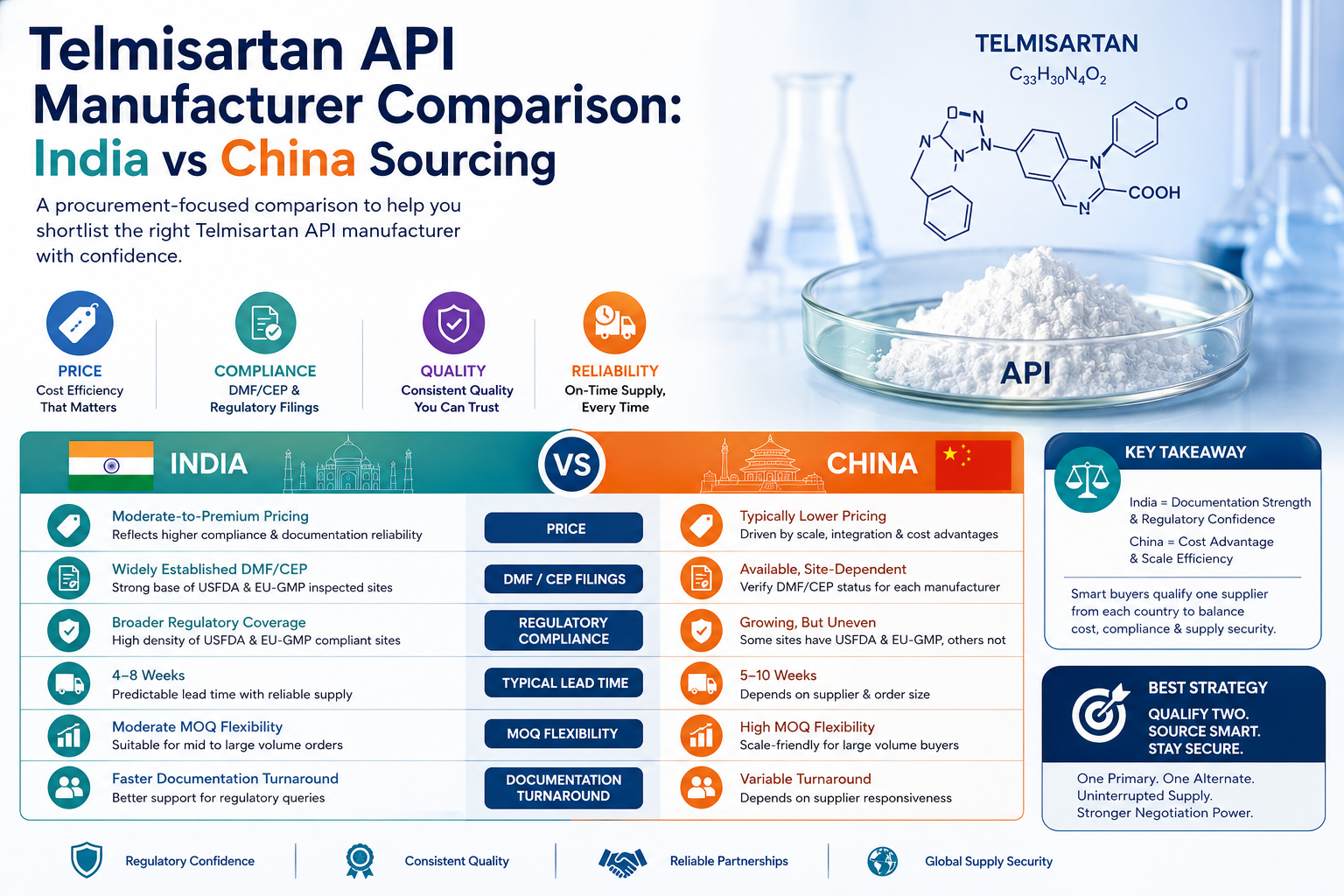
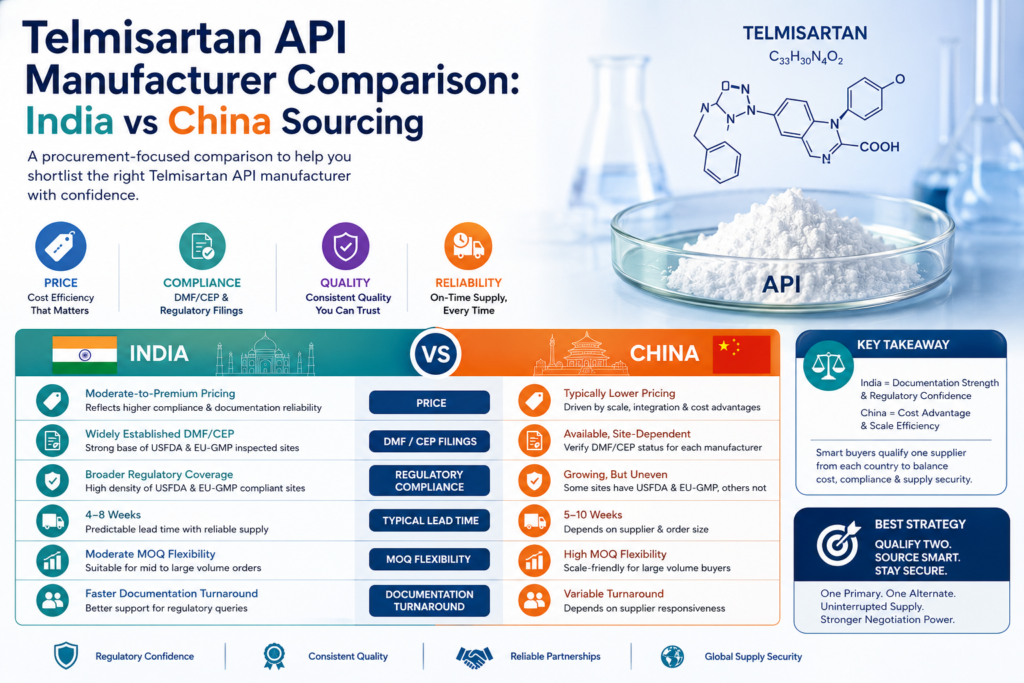
India vs China Telmisartan API — Side-by-Side Comparison
| Parameter | India | China |
|---|---|---|
| Indicative Pricing | Moderate-to-premium | Typically lower |
| DMF / CEP Filings | Widely established | Available, site-dependent |
| USFDA / EU-GMP Density | Broader supplier base | Growing, uneven across sites |
| Typical Lead Time | 4–8 weeks | 5–10 weeks |
| MOQ Flexibility | Moderate, negotiable | High, scale-friendly |
| Documentation Turnaround | Generally faster | Variable |
| Supply Chain Concentration Risk | Moderate | Higher, due to regional export dependencies |
India — Best Fit
Formulators targeting regulated markets (US, EU) who prioritize documentation reliability, faster regulatory query response, and a broader pool of pre-approved DMF/CEP sites.
China — Best Fit
Buyers with large, predictable volume needs where unit cost is the primary lever, and where in-house technical teams can manage rigorous supplier qualification.
Key Factors to Evaluate Before Choosing an API Supplier
Regulatory Documentation
Confirm the manufacturer holds an active, non-withdrawn DMF or CEP specific to Telmisartan, and that the filing covers the polymorphic form and particle size specification your formulation requires.
Plant Audit History
Request the site’s most recent inspection outcome. A history of repeat USFDA Form 483 observations or an active import alert is a stronger risk signal than country of origin alone.
Batch Consistency and Impurity Profile
Given the sartan-class nitrosamine impurity concerns, ask for validated nitrosamine testing data (e.g., NDMA, NDEA limits) across multiple recent batches, not just a single Certificate of Analysis.
Supply Chain and Geopolitical Risk
Factor in export control changes, regional logistics disruptions, and single-source dependency — all of which can affect continuity regardless of how strong the manufacturer’s quality system is.
Total Landed Cost
Unit price alone is misleading. Total landed cost should include freight, import duties, quality-failure/rejection risk, and the internal cost of extended regulatory correspondence.
Vendor Qualification Checklist
- Valid, current DMF or CEP specific to Telmisartan API
- WHO-GMP / ICH Q7 compliance confirmed with certificate copies
- Clean recent regulatory inspection history (no unresolved 483s or import alerts)
- Nitrosamine impurity data across at least three recent batches
- Confirmed manufacturing capacity against your annual volume forecast
- Documented lead time and contingency plan for delayed shipments
Risks and Challenges in Each Sourcing Region
India-Specific Challenges
Capacity at top-tier, fully certified sites can tighten during peak demand cycles, occasionally pushing lead times out and creating upward price pressure for smaller-volume buyers.
China-Specific Challenges
Regulatory scrutiny has intensified in recent years, and evolving trade and export dynamics between China and Western markets can introduce logistics or tariff-related uncertainty that buyers should monitor on an ongoing basis.
Hybrid Sourcing Strategy: Is a Dual-Vendor Approach Better?
Many mid-to-large generic manufacturers now qualify a primary and an alternate Telmisartan API source — commonly one from each country — and list both as approved sources within the same regulatory dossier. This spreads supply risk, creates pricing leverage during negotiation, and protects production continuity if either supplier faces a plant-level disruption or audit finding.
A single-source API strategy optimizes for cost today; a dual-source strategy optimizes for continuity over the life of the product.
How to Choose the Right Telmisartan API Manufacturer
Beyond price and certification, run a short structured evaluation before committing to a supplier:
- Verify the DMF/CEP status directly against the relevant regulatory database rather than relying solely on the supplier’s claim.
- Request a pilot batch and independently test it against your specification before committing to full-scale procurement.
- Ask for three supplier references currently using the API in a marketed or pipeline product.
- Clarify change-control policy — how the manufacturer notifies you of process or site changes that could affect your filing.
Red Flags to Watch For
- Reluctance to share recent inspection or audit reports
- Pricing significantly below market average with no clear cost explanation
- Inconsistent Certificate of Analysis formatting across batches
- No clear escalation contact for regulatory queries
Frequently Asked Questions
Is Indian or Chinese Telmisartan API cheaper?
Chinese Telmisartan API is typically priced lower on a per-kilogram basis due to scale and integrated intermediate production. India, however, often works out cheaper on a total landed cost basis for regulated-market buyers once documentation support and rejection risk are considered.
Which country has stricter API quality standards, India or China?
Quality depends on the individual manufacturer’s certifications and audit history rather than the country as a whole. India currently has a broader base of USFDA and EU-GMP inspected Telmisartan API sites, giving buyers more established, pre-vetted options for regulated markets.
What certifications should a Telmisartan API supplier have?
At minimum, look for an active CEP or USDMF filing, WHO-GMP or ICH Q7 compliance, and — for regulated-market sales — a clean USFDA or EU-GMP inspection history.
Can I source Telmisartan API from both India and China simultaneously?
Yes. Dual-vendor sourcing across both countries is common practice for supply risk mitigation, and most regulatory filings can accommodate a second approved API source as an alternate DMF/CEP holder.
What is the typical lead time for Telmisartan API import?
Lead times generally range from four to eight weeks from India and five to ten weeks from China, depending on batch readiness, documentation turnaround, and the shipping mode used.
Conclusion — Making the Right Sourcing Decision
Neither India nor China is a universally “better” source for Telmisartan API from Telmisartan API Manufacturer — the right decision depends on your target regulatory market, order volume, and appetite for supply chain risk. India generally offers stronger documentation depth and a wider bench of regulated-market-ready sites; China generally offers a cost advantage at scale. For most formulators shipping into the US or EU, a qualified primary-and-alternate approach across both countries delivers the best balance of cost efficiency and continuity.
Follow us on Instagram : rokadoverseas