 Rajat Sharma
A procurement-focused guide to the key intermediates behind Lercanidipine API synthesis — verified CAS numbers, specification parameters, and a practical checklist for vetting intermediate suppliers.
Quick Answer
Lercanidipine Intermediates ‘s synthesis runs through a dihydropyridine-acid stage and a diphenylpropylamine side-chain stage before final coupling. Suppliers often label these stages with internal shorthand — DPA, LRD, LRCII being common examples — but these trade codes are not standardized across the industry. Before ordering, always confirm the CAS number, molecular formula, and IUPAC name behind any trade code the supplier quotes, rather than relying on the code alone.
What Is Lercanidipine and Why Its Intermediates Matter
Lercanidipine is a third-generation dihydropyridine calcium channel blocker used in the management of hypertension. It is manufactured via a multi-step synthesis that couples a dihydropyridine-acid core with a diphenylpropylamine-based side chain. Because the finished API’s purity and impurity profile are directly inherited from the intermediates used upstream, the specification and documentation quality of each intermediate has a direct bearing on API filing success and batch consistency.
For CDMOs and API manufacturers, sourcing these intermediates correctly is not just a cost exercise — it directly affects regulatory risk, since impurities carried over from a poorly characterized intermediate can surface as unexplained related substances in the final API’s Certificate of Analysis.
Understanding the Lercanidipine Synthesis Route
At a high level, Lercanidipine’s synthesis proceeds through two parallel intermediate streams that converge in a final coupling (esterification) step:
- Dihydropyridine-acid stage — builds the nitrophenyl-dihydropyridine core carrying a free carboxylic acid group.
- Diphenylpropylamine side-chain stage — builds the amino-alcohol side chain that will later become the ester-linked branch of the molecule.
- Coupling/esterification stage — the acid and the side-chain alcohol are joined (commonly via acid chloride activation) to form Lercanidipine, which is then isolated as its hydrochloride salt.
Each of these stages produces at least one isolable, purchasable intermediate — and it’s these intermediates that manufacturers commonly assign shorthand trade codes to on quotations and packing lists.
Verified Lercanidipine Intermediates: Specs and CAS Numbers
The two intermediates below are independently indexed under public CAS registrations and are widely available from Indian and Chinese suppliers. Use these as your reference point when cross-checking any supplier’s quotation, regardless of what trade code they use.
Dihydropyridine-Acid Intermediate
Chemical name: 2,6-Dimethyl-5-methoxycarbonyl-4-(3-nitrophenyl)-1,4-dihydropyridine-3-carboxylic acid
CAS Number: 74936-72-4
Molecular Formula: C₁₆H₁₆N₂O₆
Molecular Weight: 332.31
Appearance: Off-white to pale yellow crystalline powder
Typical Assay Spec: ≥98.0% (HPLC)
Note: This is a shared intermediate — it is also used in the synthesis of several other dihydropyridine-class actives (e.g., nicardipine, manidipine, benidipine), so suppliers offering it may quote it against multiple end applications.
Diphenylpropylamine Side-Chain Intermediate
Chemical name: 2,N-Dimethyl-N-(3,3-diphenylpropyl)-1-amino-2-propanol
CAS Number: 100442-33-9
Molecular Formula: C₂₀H₂₇NO
Molecular Weight: 297.43
Appearance: Colorless to pale yellow viscous oil
Typical Assay Spec: ≥98.0% (HPLC)
Note: This compound is also listed by some suppliers under the synonym “Lercanidipine EP Impurity E” and appears on EP/USP impurity reference standard catalogs, so it may be quoted either as a bulk intermediate or as an analytical reference standard — confirm which one you’re ordering.
A Note on DPA, LRD, and LRCII Trade Codes
If you’ve seen “DPA,” “LRD,” or “LRCII” on a supplier’s quotation or packing list, these are almost always internal shorthand codes, not standardized chemical nomenclature. Unlike a CAS Registry Number, which is assigned once and never reused, trade codes are set by each manufacturer independently — which means the same code can refer to different compounds, or different purity grades of the same compound, depending on which supplier issued it.
This is a common pattern across the intermediate trade generally, not specific to Lercanidipine. The practical takeaway for buyers: treat any trade code as a label, not a specification. Always ask the supplier to confirm the CAS number, IUPAC name, and molecular formula behind their code before issuing a purchase order.
A trade code tells you what a supplier calls something. Only a CAS number and molecular structure tell you what it actually is.
Regulatory and Documentation Requirements for Intermediates
Certificate of Analysis (COA)
A usable COA for an intermediate should state the CAS number, batch number, assay result with test method (typically HPLC), individual and total related substances, water content (Karl Fischer), residual solvents where applicable, and appearance/melting point where relevant.
Do Intermediates Need a DMF or CEP?
Generally, no — intermediates are typically supported by a COA and a technical specification sheet rather than a full DMF/CEP, since those filings apply to the finished API. That said, regulators increasingly expect API manufacturers to demonstrate control over their upstream supply chain, so having a stable, well-documented intermediate source strengthens your own DMF’s supply chain section.
Impurity Profiling
Ask for a related-substances breakdown, not just a total impurity figure. An unusually high single unknown impurity, even within an acceptable total limit, can complicate your own API’s impurity qualification later.
Supplier Checklist for Lercanidipine Intermediates
Vendor Qualification Checklist
- CAS number, molecular formula, and IUPAC name confirmed independently — not taken solely from the supplier’s trade code
- Current COA showing assay, related substances, water content, and residual solvents
- Manufacturing capability matched to your required batch size and delivery schedule
- MSDS/SDS available and current
- GMP status disclosed (even if non-GMP, it should be stated explicitly, not left ambiguous)
- Willingness to supply a pilot/sample batch before bulk commitment
- Clear MOQ, lead time, and packaging terms in writing
India vs China Sourcing for Lercanidipine Intermediates
Both India and China have an established manufacturing base for dihydropyridine-class intermediates, and Lercanidipine’s building blocks are no exception.
India
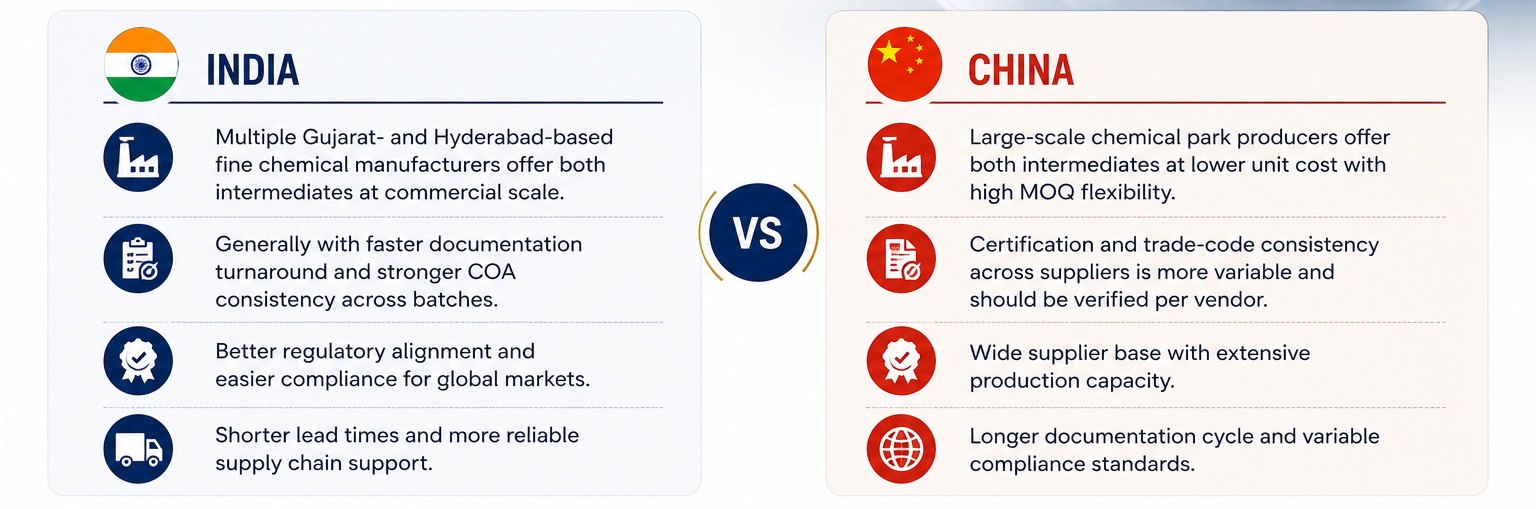
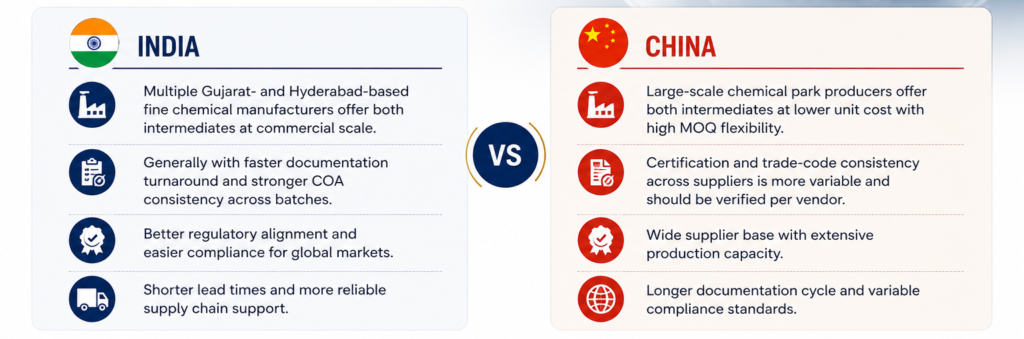
Multiple Gujarat- and Hyderabad-based fine chemical manufacturers offer both intermediates at commercial scale, generally with faster documentation turnaround and stronger COA consistency across batches.
China
Large-scale chemical park producers offer both intermediates at lower unit cost with high MOQ flexibility, though certification and trade-code consistency across suppliers is more variable and should be verified per vendor.
For a deeper look at how India and China compare on cost, documentation, and lead time for finished APIs (the same dynamics largely apply to intermediates), see our Telmisartan API sourcing comparison.
Common Risks and Red Flags When Sourcing Intermediates
- A quotation that lists only a trade code, with no CAS number offered until specifically requested
- Assay or related-substances figures that don’t change from batch to batch (suggesting the COA is a template, not real test data)
- Reluctance to provide a small sample for independent testing before a bulk order
- No clear answer on whether the material is GMP or non-GMP grade
How to Evaluate and Qualify a New Intermediate Supplier
- Cross-check the CAS number against an independent chemical database before accepting the supplier’s trade code as accurate.
- Request a small sample and run independent HPLC/assay testing against your internal specification.
- Ask for two to three recent COAs from different batches to check for genuine batch-to-batch variation (a sign of real testing, not copy-paste documentation).
- Confirm packaging, labeling, and lead time in writing before placing a bulk purchase order.
Frequently Asked Questions
What is the CAS number of the Lercanidipine dihydropyridine-acid intermediate?
The dihydropyridine-acid intermediate — 2,6-dimethyl-5-methoxycarbonyl-4-(3-nitrophenyl)-1,4-dihydropyridine-3-carboxylic acid — carries CAS number 74936-72-4. This intermediate is also used in the synthesis of several other dihydropyridine-class calcium channel blockers.
What is the CAS number of the diphenylpropylamine side-chain intermediate?
The side-chain amino-alcohol intermediate — 2,N-dimethyl-N-(3,3-diphenylpropyl)-1-amino-2-propanol — carries CAS number 100442-33-9.
Are DPA, LRD, and LRCII official chemical names?
No. These are commonly used as internal trade shorthand by individual intermediate manufacturers rather than standardized chemical nomenclature. The same code can mean different things across different suppliers, so always confirm the CAS number and molecular structure directly.
Do Lercanidipine intermediates require a DMF?
Typically not. Intermediates are usually supported by a Certificate of Analysis and a technical specification sheet rather than a full DMF or CEP, which apply to the finished API rather than its upstream intermediates.
Can Lercanidipine intermediates be sourced from both India and China?
Yes. Both countries have established manufacturers for these intermediates, and many buyers qualify a supplier in each region to balance cost against documentation reliability and supply continuity.
Conclusion — Sourcing Lercanidipine Intermediates with Confidence
Getting Lercanidipine intermediate sourcing right comes down to three things: verifying the real chemical identity behind any trade code, insisting on complete and consistent COA documentation, and qualifying suppliers through independent sample testing rather than paperwork alone. Trade codes like DPA, LRD, and LRCII are useful shorthand once you’ve confirmed what they actually refer to — but they should never substitute for a verified CAS number and specification sheet.
Follow us on Instagram : rokadoverseas