 Rajat Sharma
Linagliptin Intermediates synthesis converges three separate building blocks into one molecule. Here’s how those stages map to trade-shorthand codes like BMX, CMQ, and BMP — and why you should verify the real chemistry behind any code before ordering.
📅 Updated August 2026⏱ 10 min read🏷 API Chemistry
Quick Answer
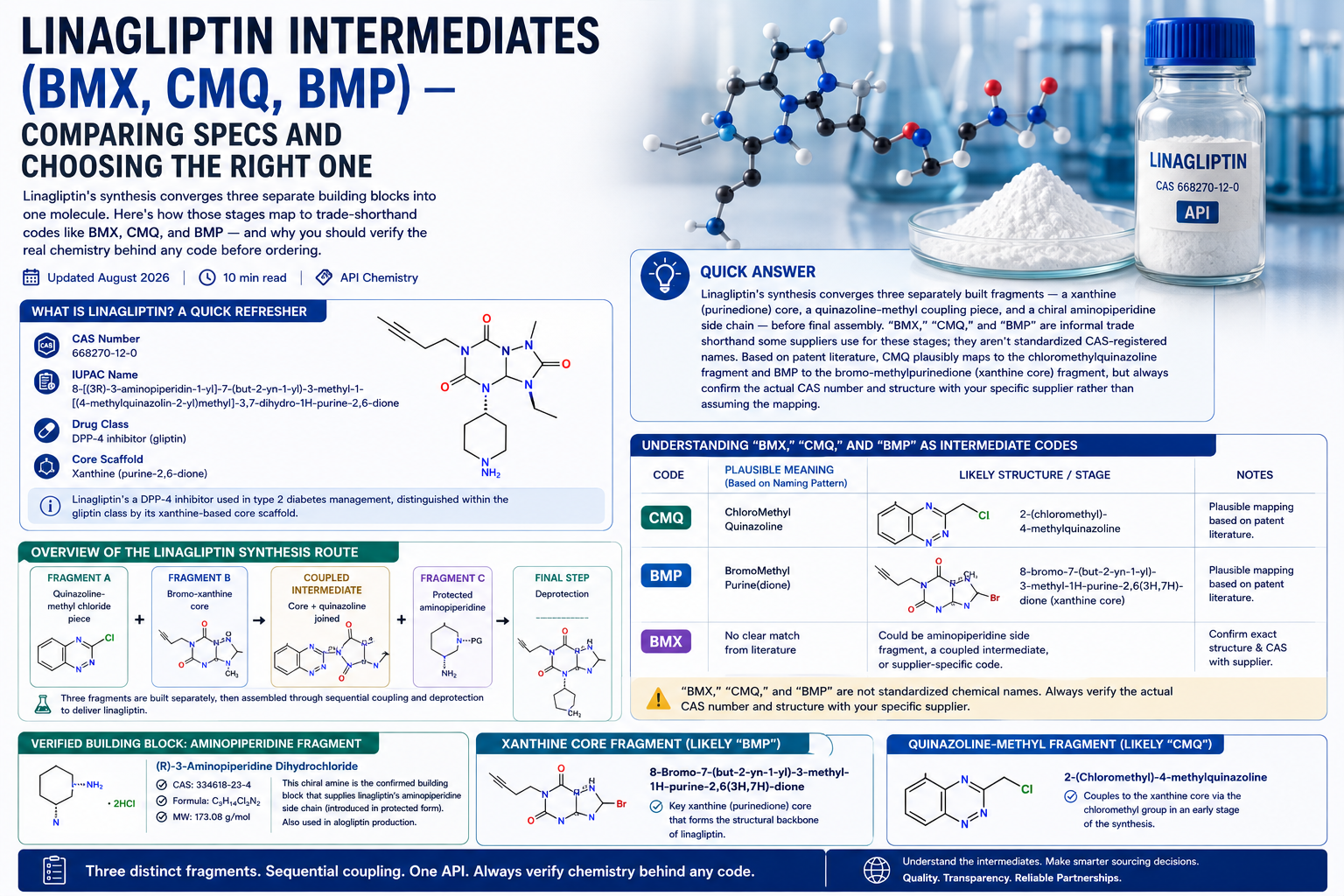
Linagliptin’s synthesis converges three separately built fragments — a xanthine (purinedione) core, a quinazoline-methyl coupling piece, and a chiral aminopiperidine side chain — before final assembly. “BMX,” “CMQ,” and “BMP” are informal trade shorthand some suppliers use for these stages; they aren’t standardized CAS-registered names. Based on patent literature, CMQ plausibly maps to the chloromethylquinazoline fragment and BMP to the bromo-methylpurinedione (xanthine core) fragment, but always confirm the actual CAS number and structure with your specific supplier rather than assuming the mapping.
What Is Linagliptin Intermediates? A Quick Refresher
CAS Number668270-12-0IUPAC Name8-[(3R)-3-aminopiperidin-1-yl]-7-(but-2-yn-1-yl)-3-methyl-1-[(4-methylquinazolin-2-yl)methyl]-3,7-dihydro-1H-purine-2,6-dioneDrug ClassDPP-4 inhibitor (gliptin)Core ScaffoldXanthine (purine-2,6-dione)
Linagliptin is a DPP-4 inhibitor used in type 2 diabetes management, distinguished within the gliptin class by its xanthine-based core scaffold — a structural family it shares only with itself among the major commercial gliptins (vildagliptin and saxagliptin use adamantane-based scaffolds, while alogliptin uses a pyrimidinedione core). We covered linagliptin’s mechanism and its place in the broader gliptin class in detail in our companion article on DPP-4 inhibitor intermediates; this article goes deeper into linagliptin’s specific synthesis stages.
What sets linagliptin apart from a sourcing perspective is synthesis complexity: unlike vildagliptin, which couples just two fragments, linagliptin’s route requires building and joining three distinct pieces.
Overview of the Linagliptin Synthesis Route
Linagliptin is built through a convergent synthesis: three separate fragments are constructed independently, then assembled through sequential coupling steps. Based on the industrial process documented in peer-reviewed process-impurity literature, the route proceeds roughly as follows:
Fragment A Quinazoline-methyl chloride piece
+
Fragment B Bromo-xanthine core
→
Coupled Intermediate Core + quinazoline joined
+
Fragment C Protected aminopiperidine
The coupled core-plus-quinazoline intermediate is then reacted with the protected aminopiperidine fragment, and a final deprotection step reveals the free amine, yielding linagliptin. This is why linagliptin needs three building blocks rather than two: the xanthine core, the quinazoline-methyl substituent, and the aminopiperidine side chain are structurally unrelated pieces that must each be synthesized or sourced on their own before assembly.
Understanding “BMX,” “CMQ,” and “BMP” as Intermediate Codes
A note on naming: “BMX,” “CMQ,” and “BMP” are not standardized, CAS-registered chemical names — we could not locate a public chemical database or patent that consistently defines these exact codes. As with the trade shorthand seen in Lercanidipine and Dapagliflozin sourcing, these appear to be internal labels individual suppliers assign on their own quotations, which means the same code can vary in meaning between manufacturers.
That said, based on verified patent literature describing linagliptin’s actual synthesis fragments, a plausible (though unconfirmed) mapping emerges from the naming pattern itself:
- CMQ — plausibly short for ChloroMethylQuinazoline, matching the documented fragment 2-(chloromethyl)-4-methylquinazoline
- BMP — plausibly short for BromoMethylPurine(dione), matching the documented xanthine-core fragment 8-bromo-7-(but-2-yn-1-yl)-3-methyl-1H-purine-2,6(3H,7H)-dione
- BMX — no clear structural match emerged from available literature; this could refer to the aminopiperidine-side fragment, a coupled intermediate, or a supplier-specific designation entirely unrelated to the naming pattern above
Treat this mapping as a reasonable hypothesis based on naming convention, not a confirmed fact — always ask your supplier directly which synthesis stage and CAS number their code refers to.
The Verified Intermediate Behind the Aminopiperidine Fragment
Verified Building Block
(R)-3-Aminopiperidine Dihydrochloride — CAS 334618-23-4, C₅H₁₄Cl₂N₂, MW 173.08
This chiral amine is the confirmed, CAS-documented building block that supplies linagliptin’s aminopiperidine side chain. It’s introduced onto the xanthine core (via its protected form) late in the synthesis sequence. This is the same intermediate used in alogliptin production, making it one of the few genuinely shared building blocks across the DPP-4 inhibitor class — a detail covered in more depth in our gliptin intermediates comparison article.
The Xanthine Core and Quinazoline-Methyl Fragments
Xanthine Core Fragment (likely “BMP”)
8-Bromo-7-(but-2-yn-1-yl)-3-methyl-1H-purine-2,6(3H,7H)-dione
Documented in peer-reviewed process chemistry literature as a key intermediate in Boehringer Ingelheim’s industrial linagliptin synthesis. This fragment provides the substituted xanthine ring system that forms linagliptin’s structural core, with the bromine position serving as the coupling site for the quinazoline-methyl fragment.
Quinazoline-Methyl Fragment (likely “CMQ”)
2-(Chloromethyl)-4-methylquinazoline
Also documented in the same industrial process literature, this fragment is prepared by cyclizing 1-(2-aminophenyl)ethanone with 2-chloroacetonitrile under acidic conditions. It’s then condensed with the bromo-xanthine core fragment to build the coupled intermediate that eventually becomes linagliptin’s quinazoline-methyl substituent.
Both of these fragments are considerably more linagliptin-specific than the shared aminopiperidine building block — neither shows up in alogliptin, dapagliflozin, or other gliptin/gliflozin synthesis routes, which makes sense given linagliptin’s unique xanthine scaffold.
Comparing Specs Across the Three Intermediate Stages
| Trade Code (Unverified) | Likely Synthesis Stage | Verified Structural Basis | Key Spec Considerations |
|---|---|---|---|
| CMQ | Quinazoline-methyl fragment | 2-(Chloromethyl)-4-methylquinazoline | Chloride reactivity/stability; related-substance control for downstream coupling |
| BMP | Xanthine core fragment | 8-Bromo-7-(but-2-yn-1-yl)-3-methyl-1H-purine-2,6(3H,7H)-dione | Bromide coupling-site purity; alkyne group stability |
| BMX | Unconfirmed — possibly aminopiperidine-side or a coupled intermediate | Not independently verified; may correspond to (R)-3-aminopiperidine derivative or a protected coupling intermediate | Confirm CAS and stereochemistry directly with supplier before ordering |
How to Choose the Right Intermediate for Your Route
Before Ordering, Confirm:
- Which specific synthesis stage your process patent or route documentation actually calls for
- The exact CAS number and structure behind any trade code the supplier quotes
- Whether the fragment is offered as a free base, salt form, or protected derivative — this affects downstream reaction stoichiometry
- Batch-specific COA data, including assay and related substances, rather than a generic template
The most common costly mistake in this category isn’t picking the “wrong” fragment outright — it’s assuming a trade code maps cleanly onto your process without checking, only to discover a stereochemistry, salt-form, or protecting-group mismatch once the material arrives.
Why Getting This Right Matters
A mismatched intermediate doesn’t just cause a wasted purchase — it can stall an entire synthesis batch if the wrong protecting group or salt form doesn’t behave as expected in your specific coupling step. Beyond the immediate mismatch risk, impurity carryover from any of these three fragments feeds directly into linagliptin’s final impurity profile, which is part of why the peer-reviewed process-impurity literature referenced throughout this article specifically traces how incomplete conversion at the core or quinazoline coupling stages produces identifiable downstream impurities in the finished API.
Getting the fragment identity right upfront is the foundation for the next step: actually vetting a specific supplier’s documentation, certification, and batch consistency — covered in our WHO-GMP supplier vetting guide.
Frequently Asked Questions
What are BMX, CMQ, and BMP in linagliptin manufacturing?
BMX, CMQ, and BMP are informal trade shorthand some suppliers use for linagliptin’s three synthesis-stage intermediates. They are not standardized, CAS-registered names. Based on patent literature, CMQ plausibly corresponds to the chloromethylquinazoline fragment and BMP to the bromo-methylpurinedione (xanthine core) fragment, given the naming pattern, but this mapping should be confirmed with the specific supplier rather than assumed.
Are BMX, CMQ, and BMP standardized names across suppliers?
No. Unlike CAS Registry Numbers, these trade codes are assigned independently by individual suppliers and are not standardized across the industry, so the same code could refer to different compounds or grades depending on the manufacturer.
What is the key shared intermediate between linagliptin and alogliptin?
(R)-3-Aminopiperidine dihydrochloride (CAS 334618-23-4) is the key chiral amine building block shared between linagliptin and alogliptin, since both drugs incorporate the same aminopiperidine side chain despite having different core scaffolds.
Why does linagliptin need three separate building blocks instead of two?
Linagliptin’s structure combines a substituted xanthine core, a chiral aminopiperidine side chain, and a quinazoline-methyl substituent, all of which must be synthesized or sourced separately and then assembled through sequential coupling steps, unlike simpler gliptins such as vildagliptin that couple just two fragments.
How do I confirm which intermediate my synthesis route actually needs?
Compare your process patent or route documentation against the CAS number and structure a supplier provides, rather than relying on a trade code name. Request a Certificate of Analysis and independently verify the structure before committing to an order.
Conclusion — Understanding Linagliptin Intermediates Before You Source
Linagliptin’s three-fragment convergent synthesis means there are genuinely three separate intermediates to get right, not one. The xanthine core and quinazoline-methyl fragments are well documented in patent literature, even if the exact trade codes suppliers use for them (“BMX,” “CMQ,” “BMP”) aren’t standardized. The aminopiperidine fragment, by contrast, is fully verified and even shared with alogliptin. Before sourcing any of these, match the fragment to your actual process documentation and confirm the real CAS number and structure — not just the trade name on the quotation.