 Rajat Sharma
What this vildagliptin intermediate is, where it fits in the synthesis route, and a practical checklist for evaluating a manufacturer before you engage one.
📅 Updated August 2026 | ⏱ 9 min read | 🏷 API Intermediates
Quick Answer
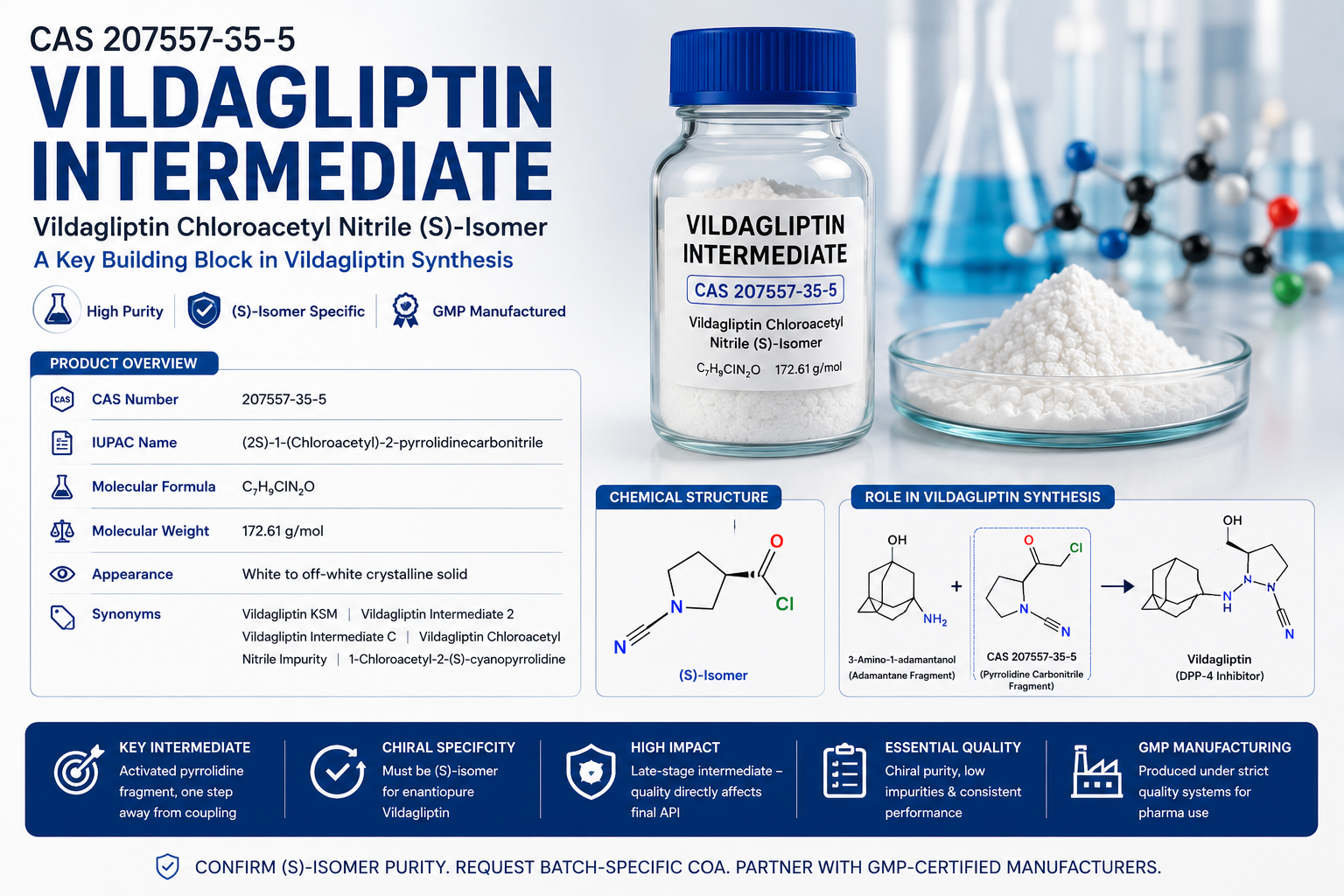
CAS 207557-35-5 is Vildagliptin Chloroacetyl Nitrile (S)-Isomer — (2S)-1-(Chloroacetyl)-2-pyrrolidinecarbonitrile, C₇H₉ClN₂O, MW 172.61 — a key intermediate in vildagliptin’s synthesis, sometimes marketed as “Vildagliptin KSM.” Before choosing a manufacturer, confirm chiral purity (this must be the (S)-isomer, not racemic), request a batch-specific COA with related-substances and optical rotation data, and verify GMP status directly rather than relying on the product’s trade name alone.
What Is CAS 207557-35-5?
CAS Number: 207557-35-5
IUPAC Name: (2S)-1-(Chloroacetyl)-2-pyrrolidinecarbonitrile
Molecular Formula: C₇H₉ClN₂O
Molecular Weight: 172.61 g/mol
Appearance: White to off-white crystalline solid
This compound is widely referred to by its descriptive name, Vildagliptin Chloroacetyl Nitrile (S)-Isomer, and is documented consistently across multiple independent supplier catalogs and chemical databases under CAS 207557-35-5. It circulates under a number of synonyms and trade descriptions, which is worth knowing before you start requesting quotes:
🏷 Vildagliptin KSM 🏷 Vildagliptin Intermediate 2 🏷 Vildagliptin Intermediate C 🏷 Vildagliptin Chloroacetyl Nitrile Impurity 🏷 1-Chloroacetyl-2-(S)-cyanopyrrolidine
All of these names refer to the same CAS-registered compound — but as with any intermediate that circulates under multiple trade names, the CAS number and structure are what you should verify, not the name a particular supplier happens to use.
Where This Intermediate Fits in Vildagliptin Synthesis
As covered in more detail in our companion article on gliptin intermediates, vildagliptin is built by coupling an adamantane-based amino alcohol fragment (3-Amino-1-adamantanol) with a pyrrolidine carbonitrile fragment. CAS 207557-35-5 is that pyrrolidine carbonitrile fragment, already activated with a chloroacetyl group ready for coupling — making it a late-stage, high-value intermediate rather than an early building block.
Because this intermediate is only one coupling reaction away from the finished API, its purity and stereochemical integrity carry directly into vildagliptin’s own quality profile — there’s very little downstream processing to “clean up” a poor-quality batch at this stage.
Why “Manufacturer Evaluation” Matters for This Intermediate Specifically
Synonym Confusion Risk
With five-plus trade names circulating for the same compound, it’s easy for a miscommunication to slip through — a buyer asking for “Vildagliptin KSM” and a supplier quoting a related but different impurity compound, for instance. Always cross-check the CAS number on any quotation against the structure you actually need.
Chiral (S)-Isomer Specificity
This intermediate carries a stereocenter and must be supplied as its (S)-isomer to be useful for vildagliptin synthesis — the drug itself is a single enantiomer. A manufacturer who can’t produce or confirm consistent chiral purity introduces a real risk of enantiomeric impurity carrying through to the finished API.
Downstream Consequences of a Poor Batch
Because this is a late-stage intermediate, any impurity or stereochemical inconsistency here has limited opportunity to be purified out before the final coupling step, making upstream quality control at this specific stage disproportionately important relative to earlier-stage intermediates.
Manufacturer Evaluation Checklist
| Evaluation Area | What to Check |
|---|---|
| Identity Confirmation | CAS number, structure, and (S)-chirality explicitly confirmed — not just the trade name |
| Documentation | Batch-specific COA, current MSDS/SDS, specification sheet |
| Certification | WHO-GMP or GMP status clearly disclosed, not implied |
| Quality Data | Assay, related substances, and optical rotation/chiral purity data |
| Manufacturing Capability | Demonstrated batch size and consistency across multiple lots |
| Commercial Terms | MOQ, lead time, and sample availability before bulk commitment |
Before You Request a Quote
- Confirm the supplier can independently verify CAS 207557-35-5 and the (S)-isomer designation, not just repeat a trade name back to you
- Request a real, batch-specific COA — ask for optical rotation or chiral HPLC data specifically, since a generic COA may omit this
- Ask directly whether the material is GMP-grade or research-grade, in writing
- Request a small sample for independent testing before committing to bulk volume
- Ask for two or three references from customers currently using the material in vildagliptin production
Red Flags When Evaluating a Manufacturer
Documentation Signals
Reluctance to confirm chiral purity or optical rotation data, or a COA that lists only overall assay with no related-substances breakdown.
Communication Signals
Vague or inconsistent answers about which synonym or trade name maps to which CAS number, or no willingness to provide a sample before a bulk order.
A supplier who can confidently discuss chiral purity for this intermediate is signaling real process control — one who can’t is signaling risk.
Frequently Asked Questions
What is CAS 207557-35-5 used for?
CAS 207557-35-5, Vildagliptin Chloroacetyl Nitrile (S)-Isomer, is used as a key synthesis intermediate in the manufacture of Vildagliptin Intermediate CAS 207557-35-5, a DPP-4 inhibitor used to treat type 2 diabetes.
Is Vildagliptin Chloroacetyl Nitrile the same as Vildagliptin KSM?
Yes, some suppliers market CAS 207557-35-5 under the trade description Vildagliptin KSM (key starting material), alongside other synonyms like Vildagliptin Intermediate 2 and Vildagliptin Chloroacetyl Nitrile Impurity. These are different trade names for the same CAS-registered compound, but always confirm the CAS number directly rather than relying on the trade name alone.
Why does chiral purity matter for this intermediate?
This intermediate is used specifically as its (S)-isomer. Since it carries a stereocenter, contamination with the (R)-isomer or a racemic mixture can carry through the synthesis and affect the final API’s chiral purity, which is a critical quality attribute for a regulated pharmaceutical product.
What documentation should a manufacturer provide for this intermediate?
At minimum, expect a batch-specific Certificate of Analysis confirming assay, related substances, and chiral purity/optical rotation, along with a current MSDS/SDS and a specification sheet confirming CAS number and structure.
Does this intermediate require a DMF?
Generally no. As a synthesis intermediate rather than the finished API, it is typically supported by a Certificate of Analysis and specification sheet rather than a Drug Master File, which applies to the finished vildagliptin API.
Conclusion — Evaluating a Manufacturer with Confidence
CAS 207557-35-5 is a well-documented, widely available vildagliptin intermediate — but its late-stage position in the synthesis route and its chiral specificity mean the details matter more than usual. Confirm chemical identity and (S)-isomer purity first, insist on batch-specific documentation with real chiral purity data, and verify GMP status explicitly before evaluating commercial terms. Getting these fundamentals right upfront is what separates a reliable long-term source from a costly mid-project surprise.
follow our instagram :rokadoverseas