 Rajat Sharma
How to vet a WHO-GMP cardiovascular intermediate supplier – step-by-step process for verifying certification, reviewing documentation, checking compliance history, and structuring a trial order — so a new supplier is properly qualified before you commit to bulk volume.
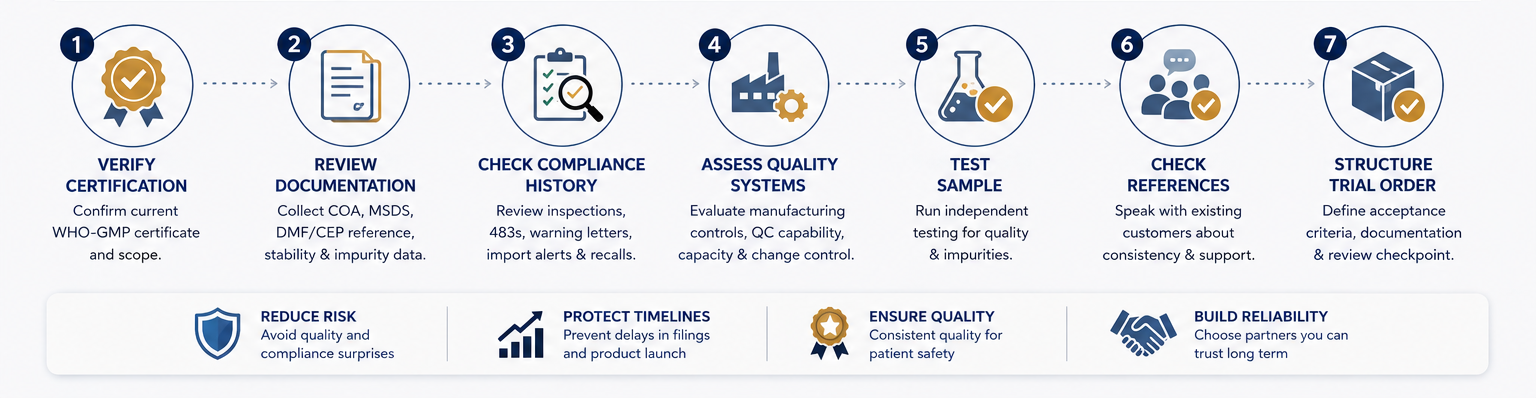
How to Vet a WHO-GMP Cardiovascular Intermediate Supplier before a trial order comes down to seven steps: verify the certificate itself, collect core documentation (COA, MSDS, DMF/CEP reference), check regulatory and compliance history, assess quality systems, independently test a sample, check references, and structure the trial order with clear acceptance criteria. WHO-GMP certification is a useful starting filter — it is not, by itself, sufficient qualification for a cardiovascular intermediate supplier.
Why Vetting Matters More for Cardiovascular Intermediates
Cardiovascular APIs sit under heavier regulatory scrutiny than many other therapeutic categories, largely a legacy of the sartan nitrosamine impurity crisis that reshaped impurity testing expectations across the entire class from 2018 onward. Regulators now expect tighter control over process-related impurities, genotoxic risk assessment, and supply chain traceability for cardiovascular intermediates specifically.
The cost of skipping proper vetting is asymmetric: a failed batch, an undisclosed impurity, or a supplier that can’t sustain consistent quality mid-way through a filing can set a cardiovascular product launch back by months, well beyond whatever was saved by choosing the cheaper, less-vetted option upfront.
What “WHO-GMP Certified” Actually Means — and What It Doesn’t
WHO-GMP certification confirms that a manufacturing site has been assessed against World Health Organization Good Manufacturing Practice guidelines and found compliant for a specific, certified scope — at the time of that inspection.
What it does not mean: it does not guarantee the supplier is ready for USFDA or EU-regulated market supply, it does not automatically cover every product line the site produces, and it does not substitute for your own documentation review, sample testing, or audit. Treat WHO-GMP status as a starting filter that narrows your supplier shortlist, not as a finish line.
WHO-GMP vs USFDA vs EU-GMP — Key Differences
| Certification | Issuing Body | Typical Market Relevance |
|---|---|---|
| WHO-GMP | National regulatory authority, per WHO guidelines | Emerging markets, WHO Prequalification Programme supply |
| USFDA Inspection | US Food and Drug Administration | Required for US market supply |
| EU-GMP | EU national competent authorities | Required for EU market supply |
A supplier may hold one, two, or all three — and the certification you actually need depends entirely on your target market, not on which certificate the supplier happens to lead with in their marketing materials.
How to Vet a WHO-GMP Cardiovascular Intermediate Supplier
STEP 1
Verify the Certification Itself
How to vet a WHO-GMP cardiovascular intermediate supplier
Don’t take a PDF certificate at face value. Confirm it’s current (certifications typically run on multi-year renewal cycles), and check that the certified scope explicitly covers the product line or intermediate category you intend to purchase — a WHO-GMP certificate for one manufacturing block doesn’t automatically extend to every building on a large multi-product site.
Where possible, cross-check the certificate against the issuing national regulatory authority’s public database rather than relying solely on the copy the supplier provides.
STEP 2
Request and Review Core Documentation
Before any commercial discussion goes further, request:
- Certificate of Analysis (COA) — should include the CAS number, batch number, assay result with method, and individual/total related substances
- MSDS/SDS — current, covering hazard classification and handling
- Site Master File or facility overview — if available, gives insight into equipment, capacity, and quality system structure
- DMF/CEP reference — if the intermediate is tied to a filed API, confirm how the intermediate supply chain is documented in that filing
- Stability and impurity data — specific to cardiovascular intermediates, given the heightened scrutiny on this class
STEP 3
Check Regulatory and Compliance History
Search for the supplier’s inspection history with USFDA and, where applicable, EU-GMP authorities, including any active import alerts. Review recent Form 483 observations or warning letters — a single historical observation isn’t automatically disqualifying, but a pattern of repeat, unresolved findings is a meaningful signal.
Also check for any past product recalls tied to the supplier, and ask directly about them if you find anything — how a supplier explains a past issue tells you as much as the issue itself.
STEP 4
Assess Manufacturing and Quality Systems
Beyond certification, look at the operational substance behind it:
- Batch record practices and a documented change-control policy for notifying customers of process or site changes
- In-house QC lab capability versus reliance on third-party testing
- Manufacturing capacity relative to your projected volume, including scale-up headroom
- Environmental and cross-contamination controls, particularly relevant where a facility handles multiple cardiovascular or other high-potency intermediates
STEP 5
Request a Sample and Run Independent Testing
A strong COA is a starting point, not proof. Request a small sample and test it independently for assay, related substances, residual solvents, and heavy metals, then compare the results directly against your internal specification — not just against what the supplier’s own COA claims.
This step alone catches a meaningful share of sourcing problems before they become production problems, and it’s the single most concrete way to validate a new supplier’s claims.
STEP 6
Ask for References and Check Them
Request two or three references from customers currently using the supplier’s material in a marketed or pipeline product. Ask about batch-to-batch consistency, responsiveness to quality queries, and whether documentation has ever needed correction after the fact.
A supplier that’s reluctant to provide any references at all, or whose references are vague and non-committal, is itself a signal worth weighing.
STEP 7
Structure the Trial Order Correctly
Size the trial order to validate consistency, not to serve as a token gesture — large enough to run real testing across at least one full batch, small enough that a failure doesn’t hurt. Set acceptance criteria in writing before the order ships, specify which documentation deliverables are tied to the batch, and agree on a review checkpoint before any conversation about scaling to bulk volume.
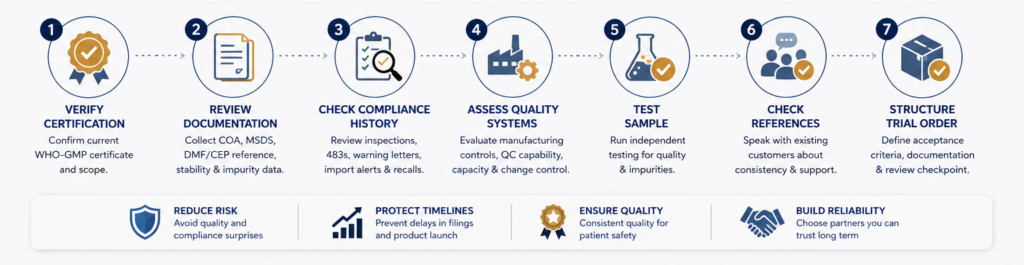
Supplier Vetting Checklist
| Step | What to Verify |
|---|---|
| Certification | Current, scope-matched WHO-GMP certificate, cross-checked against the issuing authority |
| Documentation | COA, MSDS/SDS, site overview, DMF/CEP reference, impurity/stability data |
| Compliance History | Inspection outcomes, Form 483s, warning letters, import alerts, past recalls |
| Quality Systems | Batch records, change control, QC lab capability, capacity, contamination controls |
| Sample Testing | Independent assay, related substances, residual solvents, heavy metals |
| References | Two to three current customer references, checked directly |
| Trial Order Terms | Right-sized batch, written acceptance criteria, documentation deliverables, review checkpoint |
Common Red Flags When Vetting a New Supplier
Documentation Signals
Reluctance to share audit or inspection history, generic or templated COAs, and vague answers about exactly what a WHO-GMP certificate covers.
Behavioral Signals
No willingness to provide a small sample before bulk commitment, and pricing significantly below market average with no clear explanation for the gap.
Quick Red-Flag Reference
- Won’t share recent inspection or audit reports
- COA figures are identical across every batch (suggests a template, not real testing)
- Certificate scope doesn’t clearly match the product being quoted
- No references, or references that decline to answer specific questions
- Pushes to skip the trial order and go straight to bulk volume
Frequently Asked Questions
What does WHO-GMP certification actually guarantee?
WHO-GMP certification confirms a manufacturing site meets World Health Organization Good Manufacturing Practice guidelines for the certified product scope at the time of inspection. It does not guarantee regulated-market approval, cover every product a supplier makes, or replace the need for buyer-side documentation review and testing.
How long should a trial order period last before scaling up?
Most buyers run one to three trial batches over one to three months, long enough to test batch-to-batch consistency and documentation reliability, before committing to bulk volume.
What’s the difference between WHO-GMP and USFDA-approved suppliers?
WHO-GMP certification is issued against WHO guidelines and is commonly required for emerging-market supply, while USFDA approval reflects an inspection against US regulatory standards and is typically required for supply into the US market. A supplier can hold one, both, or neither, and the requirement depends on your target market.
Should I always request an on-site audit before ordering?
An on-site audit is strongly recommended for any supplier you plan to rely on for regulated-market supply or high volume, though for smaller trial orders a thorough documentation review and independent sample testing can serve as an interim check before committing to a full audit.
What documentation is essential even for a small trial order?
At minimum, request a batch-specific Certificate of Analysis, a current MSDS/SDS, and confirmation of the supplier’s WHO-GMP certificate scope before placing even a small trial order.
Conclusion — Reducing Risk Before You Commit
WHO-GMP certification is a useful filter, but it’s the beginning of supplier qualification, not the end of it. The buyers who avoid costly mid-project supplier failures are the ones who treat certification as step one of seven — pairing it with documentation review, compliance history checks, independent testing, reference calls, and a properly structured trial order before any bulk commitment. For cardiovascular intermediates specifically, where regulatory scrutiny is higher than average, that extra diligence upfront is what protects your filing timeline later.
Follow us on Instagram : rokadoverseas