 Rajat Sharma
A technical guide to how CCB intermediates for lercanidipine and cilnidipine are synthesized — covering Hantzsch chemistry, key intermediate stages, quality control, and GMP compliance for generic manufacturers.
Lercanidipine · 3rd Gen CCB
Cilnidipine · L/N-Type CCB
Hantzsch DHP Chemistry
QUICK ANSWER
Calcium channel blocker (CCB) intermediates for drugs like lercanidipine and cilnidipine are synthesized through multi-step organic chemistry routes built on the 1,4-dihydropyridine (DHP) scaffold — most commonly via the Hantzsch condensation reaction. Each route produces a series of controlled intermediate compounds that are individually tested for purity before being carried forward to the final API. The specific ester side chains on each molecule dictate the complexity and number of intermediate stages required.
Table of Contents
- What Are Calcium Channel Blocker (CCB) API Intermediates?
- The Hantzsch Dihydropyridine Reaction: Foundation of CCB Synthesis
- Lercanidipine Intermediate Synthesis: Step-by-Step
- Cilnidipine Intermediate Synthesis: Step-by-Step
- Side-by-Side Comparison: Lercanidipine vs. Cilnidipine
- Quality Control & GMP Compliance for CCB Intermediates
- What Generic Manufacturers Must Evaluate When Sourcing
- Frequently Asked Questions
Lercanidipine and cilnidipine are among the fastest-growing generic cardiovascular APIs globally — yet their synthesis is among the most chemically demanding in the entire CCB class. Most pharmaceutical procurement teams understand what these drugs do; far fewer understand the intermediate chemistry that determines their quality, regulatory acceptance, and ultimately, patient safety.
This guide breaks down the synthesis routes for CCB intermediates in lercanidipine and cilnidipine — from the foundational Hantzsch reaction through each discrete intermediate stage, the critical quality control checkpoints, and what generic manufacturers need to evaluate in their intermediate suppliers.
— Section 01
What Are Calcium Channel Blocker (CCB) API Intermediates?
CCB API intermediates are discrete chemical compounds formed at defined stages during the multi-step synthesis of a calcium channel blocker active pharmaceutical ingredient. They exist between raw starting materials and the finished API — each one must be isolated, tested, and qualified before synthesis proceeds to the next step.
The 1,4-Dihydropyridine (DHP) Scaffold
Virtually all drugs in the -dipine class — lercanidipine, cilnidipine, amlodipine, nifedipine, nitrendipine — share a common structural core: the 1,4-dihydropyridine (DHP) ring system. This six-membered nitrogen-containing ring is the pharmacologically active framework that blocks L-type calcium channels in vascular smooth muscle, causing vasodilation and blood pressure reduction.
Symmetrical vs. Unsymmetrical DHP Intermediates
The complexity of CCB intermediate synthesis is determined by whether the DHP molecule is symmetrical or unsymmetrical at the C-3 and C-5 ester positions:
- Symmetrical DHPs (e.g. nifedipine, nitrendipine): identical ester groups at C-3 and C-5 — simpler synthesis, one-pot Hantzsch route, fewer intermediates to control
- Unsymmetrical DHPs (lercanidipine, cilnidipine, amlodipine): different ester groups at C-3 and C-5 — require separate synthesis of each ester component, a Knoevenagel condensation intermediate, and a controlled coupling step; significantly more intermediate stages and quality control points
Why this matters for generic manufacturers: The moment a CCB falls into the unsymmetrical DHP category, the intermediate supply chain becomes a strategic quality function — not a commodity purchase. The purity of each intermediate directly determines whether your final API will pass bioequivalence testing and regulatory review.
— Section 02
The Hantzsch Dihydropyridine Reaction: Foundation of CCB Synthesis
The Hantzsch reaction, first reported by Arthur Hantzsch in 1881–1882, remains the foundational synthetic method for all commercially manufactured CCB APIs. Its enduring relevance reflects its chemical efficiency: it builds the pharmacologically critical DHP ring in a single convergent step from three simple components.
The Three-Component Condensation
The classical Hantzsch reaction combines:
- An aromatic aldehyde (typically 3-nitrobenzaldehyde for most blood pressure CCBs)
- Two equivalents of a β-keto ester (e.g. methyl acetoacetate, ethyl acetoacetate, cinnamyl acetoacetate)
- An amine/ammonia source (ammonium acetate, ammonium carbonate, or a primary amine)
These three components react through a cascade of aldol-type condensations, Michael addition, and cyclodehydration to yield the 1,4-DHP product.
Two Main Commercial Routes
Route A — Symmetrical Hantzsch (one-pot)
The aromatic aldehyde condenses with two equivalents of the same β-keto ester plus ammonium acetate in a single reaction vessel. Simple, high-yielding, and well-understood. Used for nifedipine, nitrendipine, and other symmetrical DHPs. Not applicable to lercanidipine or cilnidipine.
Route B — Unsymmetrical (two-component / Knoevenagel route)
The aromatic aldehyde first condenses with one β-keto ester to form a benzylidene (Knoevenagel) intermediate. This intermediate is then isolated, tested, and reacted with a different amino crotonate to close the DHP ring. This two-step approach is required whenever the C-3 and C-5 ester groups differ — as in lercanidipine and cilnidipine.
The Knoevenagel intermediate is the single most critical quality gate in unsymmetrical DHP synthesis. Any impurity introduced here — from incomplete condensation, aldol side reactions, or solvent contamination — will cascade forward into subsequent stages and is extremely difficult to remove from the final API. Its purity target is typically ≥98% before the next step proceeds.
Modern Improvements in Industrial CCB Synthesis
- Acid catalysis: Methanesulfonic acid (MsOH), p-TsOH, and picolinic acid/amine co-catalyst systems accelerate the Knoevenagel step under milder conditions with improved yield
- Solvent optimisation: Ethanol, n-butanol, DMF, and THF are preferred; solvent selection affects both yield and the residual solvent impurity profile in the intermediate
- Microwave-assisted synthesis: Dramatically reduces reaction times from 10–40 hours to under 30 minutes in continuous flow microwave reactor systems
- Continuous flow reactors: Enable tighter temperature control, consistent intermediate quality, and elimination of column chromatography purification steps for industrial-scale production
— Section 03
Lercanidipine Intermediate Synthesis: Step-by-Step
What Makes Lercanidipine Chemically Unique
The defining feature of lercanidipine is its 1,1-dimethyl-2-[N-methyl-N-(3,3-diphenylpropyl)amino]ethyl ester at C-5 — a bulky t-butylaminoethyl moiety that must be synthesised separately and coupled to the DHP nucleus in a dedicated esterification step. No existing symmetrical or two-component Hantzsch route can incorporate this side chain in situ; it must be built independently as a discrete intermediate.
Key intermediates include a symmetrical dihydropyridine precursor and this t-butyl amino ester side chain — the latter being the primary determinant of lercanidipine’s characteristic lipophilicity and pharmacokinetic profile.
Synthesis Pipeline: Stage by Stage
Stage 1
Amino Alcohol Side Chain Synthesis
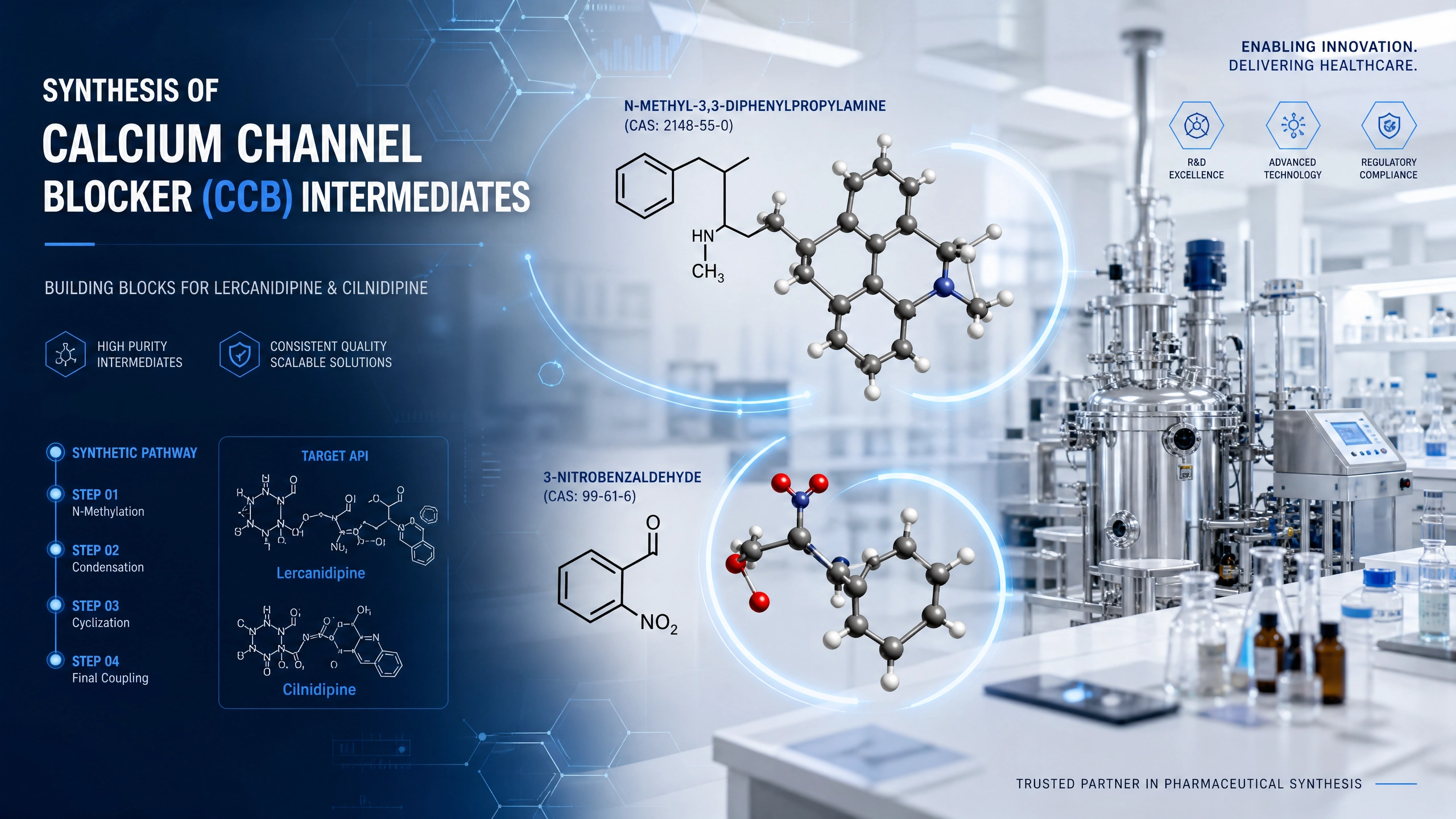
Starting from cinnamic acid: chlorination to cinnamoyl chloride → amination to N-methyl cinnamide → Friedel-Crafts alkylation with benzene to N-methyl-1,1-diphenylacetamide → carbonyl reduction to N-methyl-3,3-diphenylpropylamine. This is the key aminoalkyl side chain building block. Alternative route: direct preparation of 2-(N-methyl-N-(3,3-diphenylpropyl)amino)-1,1-dimethylethanol for direct esterification.
Stage 2
Knoevenagel Condensation → Benzylidene Intermediate
3-Nitrobenzaldehyde condenses with methyl acetoacetate in the presence of a base catalyst (piperidine/acetic acid or picolinic acid system) in an alcoholic solvent to yield the 3-nitrobenzylidene acetoacetate (benzylidene intermediate). This must be isolated at ≥98% purity before proceeding. The competing aldol side product is the primary impurity at this stage.
Stage 3
Cyclisation → DHP Monocarboxylic Acid (Parent Nucleus)
The benzylidene intermediate reacts with methyl 3-aminocrotonate in a one-pot condensation-cyclisation to form the 1,4-DHP monoester monocarboxylic acid — the parent nucleus. This is the most critical intermediate in lercanidipine synthesis. The competing dicarboxylic acid impurity is the primary process impurity requiring active HPLC monitoring.
Stage 4
Acid Chloride Activation
The DHP monocarboxylic acid is converted to its acid chloride derivative using thionyl chloride in an aprotic solvent — DMF, DMA, or THF — at controlled temperatures of −20°C to +30°C. Solvent selection and temperature control at this stage are critical: too warm and the acid chloride hydrolyses; too cold and the reaction stalls.
Stage 5
Coupling → Lercanidipine Free Base + HCl Salt Formation
The acid chloride intermediate reacts with the amino alcohol side chain (from Stage 1) in DMF, DMA, or THF at −20°C to +30°C to yield lercanidipine in pure form and high yield. The product is crystallised as lercanidipine hydrochloride from ethyl acetate. Polymorphic form control (Forms I and II, distinguished by DSC melting points of 197–201°C and 207–211°C) is an additional regulatory requirement.
Known Process Impurities — Lercanidipine
Five key process impurities must be monitored and controlled within ICH Q3A/Q3B limits: LER-1 LER-2 LER-3 LER-4 LER-D (process + degradation)
- Dicarboxylic acid impurity — from over-hydrolysis of the DHP diester during nucleus synthesis; primary process impurity
- Pyridine aromatisation product — oxidation of the DHP ring to its inactive pyridine form; generated by light or oxidant exposure
- Enantiomeric impurities — from non-stereospecific reaction steps in the amino alcohol side chain synthesis
- LER-D — both a process impurity and a photodegradation product; requires stability-indicating HPLC methods that can separate it from the primary peak
⚠ Photosensitivity Note: All DHP compounds including lercanidipine intermediates undergo photocatalytic oxidative aromatisation under UV and visible light — converting the pharmacologically active DHP ring to an inactive pyridine impurity. All synthesis, handling, and storage operations must use amber/yellow lighting and light-proof containers.
— Section 04
Cilnidipine Intermediate Synthesis: Step-by-Step
What Makes Cilnidipine Chemically Unique
The chemical name of cilnidipine is (E)-1,4-dihydro-2,6-dimethyl-4-(3-nitrophenyl)-3,5-pyridinedicarboxylic acid 2-methoxyethyl 3-phenyl-2-propenyl ester. Its two defining structural features are:
- C-5: Cinnamyl ester group — the (E)-configured 3-phenyl-2-propenyl ester; isomerisation to the (Z)-form is a key process impurity risk at every stage of synthesis
- C-3: Methoxyethyl ester group — the 2-methoxyethyl ester, a simpler but distinct second ester confirming cilnidipine’s unsymmetrical DHP classification
Synthesis Pipeline: Stage by Stage
Stage 1
Cinnamyl Ester Intermediate (C-5 Component)
Cinnamyl alcohol (3-phenyl-2-propen-1-ol) is esterified with diketene or acetoacetyl chloride to produce cinnamyl acetoacetate — the key β-keto ester that will become the C-5 ester of the DHP ring. The (E)-stereochemistry of the cinnamyl double bond must be confirmed at this stage by HPLC or GC. The (E)/(Z) ratio is the primary quality parameter for this intermediate.
Stage 2
Methoxyethyl Ester Intermediate (C-3 Component)
2-Methoxyethanol is reacted with acetoacetate derivatives to yield 2-methoxyethyl 3-aminocrotonate — the second distinct ester component needed to form the unsymmetrical DHP ring. In-situ generation is possible but reduces process control and intermediate purity assurance; isolated synthesis is preferred for regulated manufacturing.
Stage 3
Knoevenagel Condensation → Cinnamyl Benzylidene Intermediate
3-Nitrobenzaldehyde condenses with cinnamyl acetoacetate using a base catalyst (piperidine/acetic acid or picolinic acid co-catalyst) to yield the cinnamyl benzylidene intermediate. This is the most impurity-sensitive stage. Key risks: (E)→(Z) isomerisation, incomplete condensation residues, and aldol side reactions. The cinnamyl ester carboxylic acid impurity arising here is a primary known process impurity that must be monitored through to the final API.
Stage 4
Hantzsch Cyclisation → Cilnidipine
The benzylidene intermediate is reacted with 2-methoxyethyl 3-aminocrotonate in n-butanol or ethanol at reflux (100–130°C) for 6–40 hours. Catalytic acid systems (e.g. methanesulfonic acid) reduce reaction time and improve yield. Column chromatography (silica gel 100–200 mesh) followed by crystallisation achieves final API purity; industrial routes seek to eliminate the column step for cost and scale.
Known Process Impurities — Cilnidipine
- Cinnamyl ester carboxylic acid impurity — arises from the Knoevenagel condensation stage; monitored per ICH Q3A limits
- (Z)-isomer of the cinnamyl group — geometric isomer from (E)→(Z) isomerisation; biologically distinct and must be controlled throughout the full synthesis chain
- Symmetric DHP by-product — formed from unintended double use of cinnamyl acetoacetate instead of the intended unsymmetrical coupling
- Pyridine aromatisation product — oxidative aromatisation of the DHP ring; controlled through light-exclusion protocols
⚠ Photosensitivity Note (Dual Risk): Cilnidipine and its DHP intermediates carry a dual photosensitivity risk — the DHP ring aromatises under UV light, and the (E)-cinnamyl double bond can photoisomerise to the (Z)-form. Amber lighting, UV-opaque packaging, nitrogen atmosphere, and ICH Q1B photostability testing are mandatory throughout manufacturing, storage, and shipping.
— Section 05
Side-by-Side Comparison: Lercanidipine vs. Cilnidipine Intermediate Synthesis
The table below summarises key synthesis parameters, intermediate complexity, and quality control demands for both CCB intermediates — a critical reference for generic manufacturers evaluating API supplier capabilities.
| Parameter | Lercanidipine | Cilnidipine |
|---|---|---|
| DHP Type | Unsymmetrical | Unsymmetrical |
| Key Side Chain | Bulky aminoalkyl (t-butyl amino ester, C-5) | Cinnamyl ester with (E)-double bond (C-5) |
| Synthesis Steps | 6–8 steps | 4–6 steps |
| Core Route | Knoevenagel → Acid chloride coupling | Knoevenagel → Hantzsch cyclisation |
| Critical Intermediate | DHP monocarboxylic acid (parent nucleus) | Cinnamyl benzylidene intermediate |
| Primary Impurity Risk | Dicarboxylic acid; amine side chain purity | (E)→(Z) cinnamyl isomerisation |
| Stereo Consideration | Racemic; no chiral resolution required | Geometric isomer control ((E)-form only) |
| Polymorphic Control | Yes — Forms I and II (DSC) | Not typically required |
| Known Impurities | LER-1, LER-2, LER-3, LER-4, LER-D | Cinnamyl carboxylic acid, (Z)-isomer, sym DHP by-product |
| Photosensitivity | DHP ring (standard) | DHP ring + cinnamyl double bond (dual risk) |
| Regulatory Complexity | High (polymorphic forms + 5 named impurities) | Medium–High (geometric isomer control) |
| Primary Markets | EU, India, Latin America | Japan, China, India, Korea |
— Section 06
Quality Control & GMP Compliance for CCB Intermediates
Every discrete intermediate in a CCB synthesis route must be independently tested before the next reaction step proceeds. Impurity carryover from DHP intermediates is the leading cause of API batch failure in CCB manufacturing — and the most expensive to remediate.
Critical Analytical Methods
HPLC
Purity & Impurity Profiling
Primary method for quantifying all known process impurities against reference standards. Stability-indicating methods must separate degradation products from process impurities.
DSC / XRPD
Polymorphic Form
For lercanidipine HCl: DSC distinguishes Forms I (197–201°C) and II (207–211°C); XRPD confirms crystalline identity. Required for regulatory filings in the EU and US.
NMR (¹H / ¹³C)
Structural Confirmation
Confirms structural identity of each isolated intermediate and characterises impurity reference standards. Essential for (E)/(Z) configuration confirmation in cilnidipine intermediates.
MS / LC-MS
Unknown Impurity ID
Used to characterise and identify any impurity exceeding the ICH Q3A reporting threshold that is not covered by the existing reference standard library.
GC
Residual Solvents
ICH Q3C-compliant testing for residual DMF, THF, ethanol, n-butanol, and other process solvents at each intermediate and final API stage.
Karl Fischer
Moisture Content
DHP intermediates are moisture-sensitive at certain stages. Water content must be controlled to prevent hydrolysis of the DHP ring and ester bonds.
Applicable ICH & Regulatory Guidelines
- ICH Q7: Good Manufacturing Practice Guide for Active Pharmaceutical Ingredients — governs GMP requirements for all intermediate manufacturing stages
- ICH Q3A: Impurities in New Drug Substances — sets reporting, identification, and qualification thresholds for process impurities
- ICH M7: Assessment and Control of DNA Reactive (Mutagenic) Impurities — relevant for Friedel-Crafts alkylation reagents used in lercanidipine side chain synthesis
- ICH Q1B: Photostability Testing — mandatory for all DHP intermediates given their light-sensitivity
- ICH Q3C: Residual Solvents — covers DMF, THF, n-butanol, and other solvents commonly used in CCB intermediate synthesis
— Section 07
What Generic Manufacturers Must Evaluate When Sourcing CCB Intermediates
Choosing the right intermediate supplier for lercanidipine or cilnidipine synthesis is one of the most technically demanding procurement decisions a generic manufacturer makes. The following criteria should be evaluated for any CCB intermediate supplier:
Synthesis route transparency — Suppliers should disclose the full synthetic pathway and impurity generation map for each intermediate, not just the product specification sheet
Impurity reference standards availability — For lercanidipine: LER-1 through LER-D characterised reference standards; for cilnidipine: cinnamyl carboxylic acid impurity and (Z)-isomer reference standards — both per ICH M7/Q3A
Polymorphic and geometric isomer control — Critical for lercanidipine (crystal form I/II) and cilnidipine ((E)/(Z) ratio); ask for batch-level data, not just specification sheets
Photostability handling protocols — Confirm amber/yellow lighting in all synthesis areas, UV-opaque packaging, and ICH Q1B-compliant photostability testing in the QC program
Scale-up linearity data — Pilot-scale yield and impurity profiles must be reproducible at commercial scale without introducing new impurities or altering polymorphic form
GMP site certification — Confirm USFDA, EMA, PMDA (Japan), or WHO-GMP site approval; review inspection history for warning letters or import alerts related to DHP synthesis
DMF/ASMF filing capability — The supplier should be able to provide or support Drug Master File or Active Substance Master File preparation for each intermediate in regulated market filings
Technical development support — Strong suppliers offer process chemistry consultation, not just product shipment — especially valuable during ANDA scale-up and process validation stages
— Section 08
Frequently Asked Questions
Common technical questions about CCB intermediates, lercanidipine synthesis, and cilnidipine manufacturing from generic manufacturers and pharmaceutical chemists.
What is the Hantzsch reaction and why is it used to make CCB intermediates?
The Hantzsch reaction is a three-component condensation of an aromatic aldehyde, a β-keto ester, and an amine/ammonia source that produces 1,4-dihydropyridine compounds in a single convergent step. First reported in 1881–1882, it remains the foundational synthesis method for all commercially manufactured CCB APIs. Symmetrical DHP drugs (nifedipine, nitrendipine) can be made in a true one-pot Hantzsch; unsymmetrical ones (lercanidipine, cilnidipine) require the two-component Knoevenagel-modified route.
Why are lercanidipine and cilnidipine classified as unsymmetrical DHP intermediates?
Both drugs carry two different ester groups at the C-3 and C-5 positions of the DHP ring — lercanidipine with a methyl ester (C-3) and a bulky aminoalkyl ester (C-5); cilnidipine with a methoxyethyl ester (C-3) and a cinnamyl ester (C-5). This structural asymmetry requires separate synthesis of each ester component and a controlled Knoevenagel/coupling sequence — significantly increasing the number of intermediate stages and quality control requirements.
What makes cilnidipine’s synthesis different from other CCBs like nifedipine?
Cilnidipine’s cinnamyl ester side chain introduces an (E)-configured double bond that must be preserved throughout synthesis. In simpler CCBs like nifedipine (symmetrical isopropyl esters), there is no geometric isomer risk. Cilnidipine’s (E)→(Z) isomerisation is a key process impurity risk at every stage — requiring continuous monitoring of the trans/cis ratio by HPLC or GC. Additionally, cilnidipine’s dual L- and N-type channel blockade adds pharmacokinetic stringency: any impurity altering the N-type binding component may compromise its differentiated clinical profile.
Why are DHP intermediates photosensitive and how is this managed?
The 1,4-dihydropyridine ring system undergoes photocatalytic oxidative aromatisation under UV or visible light — converting the active DHP to an inactive pyridine impurity. For cilnidipine, there is a second risk: the (E)-cinnamyl double bond can photoisomerise to the (Z)-form. Management includes amber/yellow lighting in all synthesis areas, UV-opaque containers, nitrogen atmosphere packaging, and ICH Q1B photostability testing as part of the stability program.
How many synthesis steps does lercanidipine require and why?
Lercanidipine typically requires 6 to 8 chemical transformation steps, compared to 4–6 for cilnidipine and 3–4 for symmetrical CCBs like nifedipine. The additional steps arise from the need to build the bulky aminoalkyl side chain separately (a 3–4 step sequence from cinnamic acid), form the DHP nucleus via Knoevenagel condensation, activate it as an acid chloride, and couple the two fragments under cryogenic temperature control. Each step is an independent intermediate with its own quality specification, analytical testing protocol, and regulatory documentation requirement.
Source High-Purity CCB Intermediates for Lercanidipine & Cilnidipine
Looking for GMP-compliant lercanidipine or cilnidipine synthesis intermediates with full impurity reference standard support, DMF documentation, and scale-up capability? Our specialist team is ready to assist.
Follow us on Instagram : rokadoverseas